
Static data is fixed sales information collected at a point in time, while dynamic data updates automatically in real-time. Only 3% of company data meets basic quality standards and 47% of records have critical errors. Dynamic data solves this by auto-updating customer profiles, improving sales-marketing alignment, and boosting revenue by up to 209%.
Last Refreshed: March 2026 with updated statistics and tool information.
Static data is fixed sales information that does not change after collection, while dynamic data updates automatically in real-time — and only 3% of company data meets basic quality standards according to Harvard Business Review. There have been a few things that have caused a revolution in B2B sales during the last fifty years: cold calling centers, the invention of the internet, and access to data. If the first couple of innovations seems to be generally accepted and widely used, the last one needs a bit more explanation.
From Daniel Conn, GTM Strategist, graph8: “The fastest way to destroy an outbound campaign is to run it on stale data. When 47% of records have critical errors, you’re not just wasting budget — you’re training your SDRs to expect rejection as the norm. Dynamic data changes the baseline entirely.”
Each person on our planet generates 1.7 MB of data every second of the day. This is equal to storing 850 pages of a book each second. This overwhelming amount of information people willingly leave behind when surfing from one page to another online has a huge still unrevealed potential for B2B organizations.
Backed with the correct data, companies can address their audience more efficiently, build a customer-centric sales pipeline, and improve their business operations drastically. The key to success here is having access to high-quality data, which can be either static or dynamic.
If the static data type is already well-established in the B2B industry, dynamic data is somewhat of a new concept. To identify the strengths and weaknesses of each of these data types, and find out which one is better to use in B2B sales, we first need to give a clear definition of both static and dynamic data.
What Is Static Data?
Static data is any sales-related information that doesn’t change over time and is stored in the format it was initially recorded. In other words, static data includes anything that was collected at a certain point in the past, and, thus, it does not necessarily reflect the true state of things in the present. Static data can be manually updated for higher accuracy, but its format overall remains the same.
Great examples of static data in B2B are annual reports, company research, presentations, etc. These sources store a large number of insights that can help improve business operations. However, once static data is published, it gets only older and less relevant, unless there is a person appointed to manually update it.
What Is Dynamic Data?
Dynamic data is any sales-related input that updates automatically to present the most accurate data in real-time. Once a change occurs, the whole dataset transforms as well, avoiding the problem of using outdated information. With dynamic data, you can be sure that all the decision-making processes are made in accordance with the latest available knowledge, which helps to conduct business operations much more efficiently.
An example of dynamic data is the Google Analytics tool which offers you up-to-date insights into the website traffic. As for a more sales-related example, some lead management software (CRMs) support dynamic data collection as well.
Differences Between Static and Dynamic B2B Data
As a rule of thumb, static and dynamic data contain the same data points on the prospects: their name, email, phone number, job title, company size, industry, etc. However, the similarities between these two data types end here. Static data vs. dynamic data have three key differences:
1. Types of data collected
The first most obvious difference comes out of the definition: Static data records static facts, while dynamic one collects dynamic data. You can try to make static data more dynamic by constantly updating it, but the moment you refresh the page, your dataset will already be outdated.
2. Ways of collecting the data
It is believed that static data is easier to collect as this job is usually done manually by the team members or third-side parties. It is enough to have a certain source of information (like a prospect’s LinkedIn profile, or company’s website page, for example) and record everything worth noting into a general table. Once enough information is acquired, these recordings can be analyzed and used to make further decision-making processes.
Dynamic data collection, on the contrary, is fully automated. As B2B sales isn’t just about data collection but requires different activities to be conducted daily, manually updating the dataset seems simply deficient. Therefore, dynamic data is usually collected with the help of CRMs or other machine learning sales software. Once it is set up, it doesn’t really require much attention for data acquisition.
Learn more about dynamic data collection strategy.
3. Purpose of data collection
Static data is mostly used for analyzing things that happened in the past but are still valid for making business decisions today. For instance, a list of leads contacted during the last quarter can help figure out what prospects converted more than others and what channels performed the best.
Dynamic data, due to its immediate response to any slightest changes in the dataset, is most insightful for finding instant solutions to present issues. Everyday questions like “Which prospect to contact next? What channel to choose for outreach in this particular industry? At what time to send the follow-up email?” and others can be easily answered with the help of dynamic data.

Static vs. Dynamic Data Structure
The data structure is a way of storing and executing the collected information. It can be strictly fixed or quite flexible, depending on your business’s preferences and priorities.
Thus, the static data structure is usually very simple, consisting of a fixed number of columns and rows, which are decided upon by the team. The size of the entire dataset is always the same, even after updating it. When working with this type of data, the researchers usually know the exact number of pages, LinkedIn profiles, cases they need to go through, and the categories of information they need to execute.
With dynamic data structure, nothing is fixed. The amount of data points to collect is usually unknown. The only thing you can have control over is indicating the maximum memory size of the dataset in order to avoid memory collision. The dynamic data structure needs to remain flexible to be able to transform the dataset according to the latest changes in real-time. The dynamic data can both grow in size if more information gets collected and also shrink if certain input becomes outdated.
Bad data doesn’t just waste budget — it trains your team to accept poor results as normal. Clean intelligence changes everything.
“We had four primary criteria for a contact research partner: data quality, contact acquisition at scale, research team support, and the ability to build a strong working relationship based on trust. We’ve been delighted with CIENCE on all four points.” — Linda Gong, Acquisition Marketing Manager, Okta

Why Is Dynamic Data Better for B2B Sales?
Although many companies still collect static data, when it comes to sales operations, dynamic data is the future. In the battle between static vs dynamic data in B2B sales, the latter one is an obvious leader for many reasons. Here are a few most important ones:
1. Access to high-quality data in real-time
Data quality is a decisive factor that determines the success of the entire data-driven sales strategy. With incorrect information, companies are more likely to lose a customer, conduct inefficient outreach campaigns, or even seriously harm their reputation.
According to Harvard Business Review research, 47% of data records have at least one critical (e.g., work-impacting) error, and only 3% of it can be rated as “acceptable.”
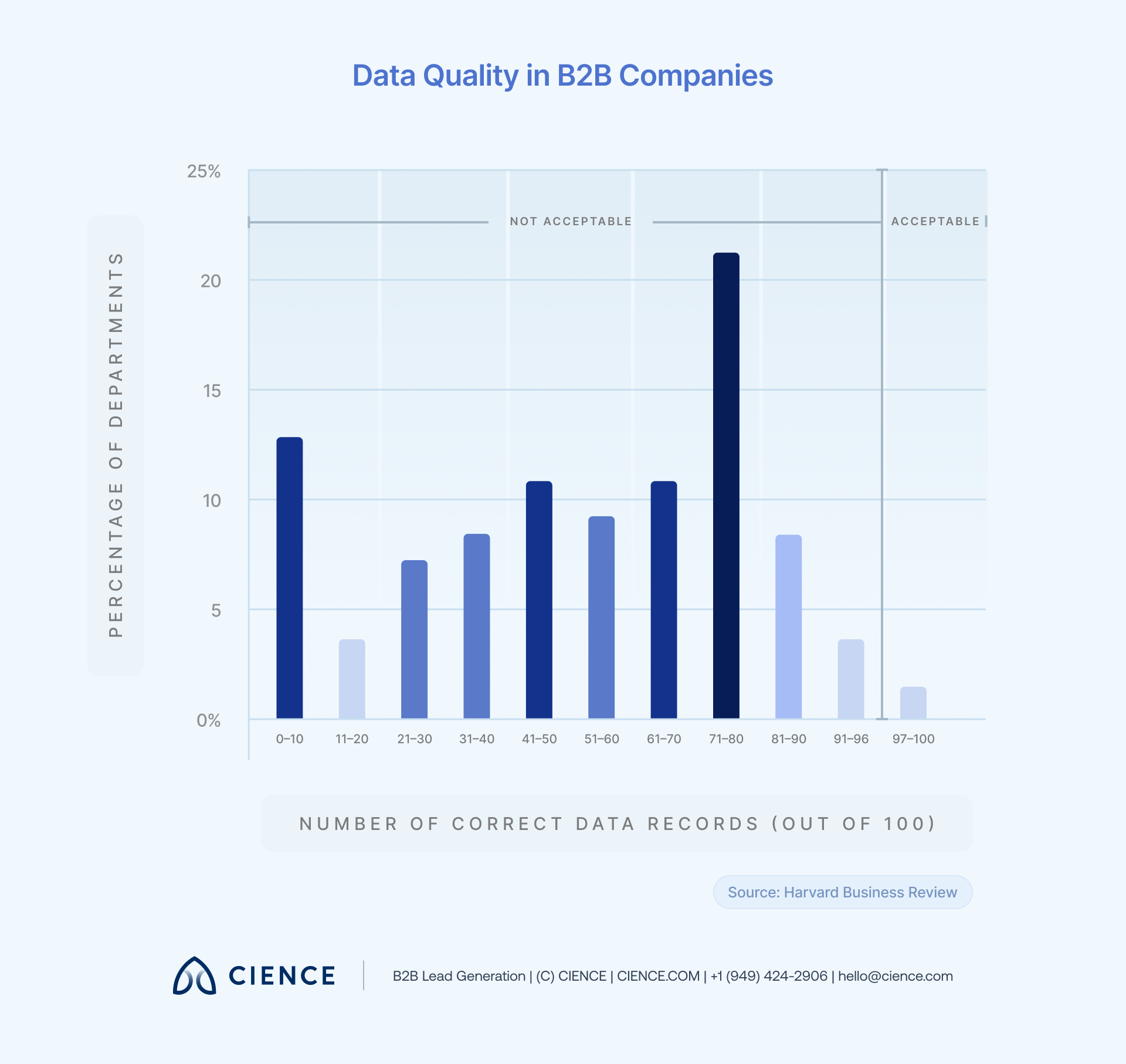
These findings only confirm how hard it actually is to maintain a high-quality data gathering. As static data is usually searched and collected manually, the possibility of a human factor error occurring is much higher compared with a fully automated dynamic data approach.
Moreover, data hygiene requires a constantly updated database with no outdated information in it. Imagine if you have a lead list of 10,000 contacts. With static data, it will take a lot of time and resources to keep it up to the minute. Dynamic data, on the contrary, will do it for you.
2. Dynamic customer profiles
Targeting relevant ideal customer profile (ICP) groups is crucial in B2B sales. As the world keeps moving—companies switch to different industries, people change their jobs, and businesses focus on overcoming different challenges—the data you address to make the key strategic decisions needs to reflect these changes. Dynamic data gives you access to the full picture, transforming your ICP according to the recent state of things. With static data, you target the ICP of the past, with dynamic data—the ICP of today.
3. Better sales and marketing team alignment
Both sales and marketing teams work together toward the same final goal—a higher conversion rate. According to Marketo, their better alignment can potentially generate over 209% more revenue and boost conversions by 67%.
When a company uses static data, it is usually distributed between different departments separately, which then use it the way they want. With dynamic data, both marketing and sales teams have access to the same dataset, which is simultaneously updated for all departments at the same time, making the communication between different teams easier to conduct.
Make Dynamic Data Your Solution for Sales
There are still a huge number of B2B companies out there who keep using static data despite its obvious disadvantages compared with dynamic data. Static data cannot satisfy the needs of the constantly changing environment companies exist in today. The immense transformations businesses have gone through in the last few years require access to fresh and up-to-date insights to help make smart data-driven business decisions. With dynamic data, you can significantly improve your sales operations and help your team achieve better results at a faster speed.
CIENCE has helped 2,500+ clients across 250+ industries move from static list-buying to dynamic, always-on data infrastructure — rated 4.6/5 on Capterra for data quality and campaign execution.
“We worked with the CIENCE team to identify better ways to build lead lists and find new approaches to viable companies — that’s what got us to 8–10 new integration sign-ups per week.” — Federico Menapace, Head of Technology Partnerships, Segment
CIENCE + graph8 pricing: $5,000 one-time GTM system setup, $2,499/mo strategic execution, and the graph8 platform at $499/mo. No long-term contracts. See full pricing →
Whether or not you decide to work with us, you’ll walk away with a clear picture of where your pipeline is leaking and what it would take to fix it.
Frequently Asked Questions
What is the difference between static and dynamic data?
Static data is sales information collected at a fixed point in time that does not automatically update — examples include annual reports, spreadsheets, and exported lead lists. Dynamic data updates automatically in real-time as changes occur, ensuring your database always reflects current information like job titles, company sizes, and contact details.
Why is dynamic data better for B2B sales?
Dynamic data is superior because 47% of data records contain at least one critical error and only 3% meet basic quality standards. Dynamic data auto-updates to eliminate outdated contacts, creates real-time customer profiles that reflect current ICP matches, and aligns sales and marketing teams on the same dataset — potentially generating 209% more revenue.
How is dynamic data collected in B2B sales?
Dynamic data collection is fully automated using CRMs, data enrichment platforms, and machine learning-powered sales software. Unlike static data, which requires manual research and spreadsheet updates, dynamic systems continuously pull from multiple sources and update records as changes occur — eliminating human error and keeping your database current without ongoing manual effort.

A graph8 company — AI-powered GTM execution across 250+ B2B industries.
graph8 Platform
From $499/mo
Run your own GTM campaigns with AI-powered data, sequences, and analytics.
Start Free — 2,500 Credits No credit card requiredCIENCE Managed
From $2,499/mo
Our GTM teams build and run your outbound campaigns end-to-end.
15-min call · No commitment2,500+ B2B companies served · Month-to-month contracts · See full pricing →