
Website visitor tracking reveals the 97% of B2B visitors who leave without converting — surfacing warm, intent-ready leads for your sales team. This guide covers 5 key benefits and reviews 9 tools, from CIENCE GO Show to Google Analytics, so you know which accounts are on your site and can act before your competitors do.
From Daniel Conn, GTM Strategist, graph8: “Most B2B teams are flying blind on their own website — they can see traffic numbers but can’t tell which target accounts are actually showing up. Visitor identification closes that gap and turns anonymous sessions into actionable pipeline signals.”
Last Refreshed: March 2026 with updated tool reviews and statistics.
Website visitor tracking is the process of identifying anonymous B2B visitors to your website and monitoring their behavior to surface warm sales leads. The best visitor tracking tools for 2026 include CIENCE GO Show, Leadfeeder, Salespanel, Crazy Egg, Hotjar, and Google Analytics — covering everything from real-time company identification to heatmaps and session recording.
Only a small fraction of website visitors convert on their own as inbound leads. Visitor tracking closes the gap by revealing who’s browsing your site, how engaged they are, and which companies they work for — giving your outbound team a pipeline of warm prospects to pursue. CIENCE has helped 2,500+ B2B clients across 250+ industries build smarter pipelines by combining sales intelligence tools like visitor tracking with intent data. Below, we cover how these tools work, 5 key benefits, and reviews of the top platforms.
What Is Website Visitor Tracking?
Website visitor tracking is a process of website visitor identification and monitoring of visitors’ activities, characteristics, and origins. The main goal is to surface potential leads arriving at your website and guide them — via personalized outreach — toward a closed deal.
Tracking website visitors helps you understand who visits your site, what they need, where they spend the most time, what actions they take, and whether they’re a fit for your product. This data equips your marketing and sales teams to accelerate B2B lead generation without waiting for visitors to raise their hand.
Why Is B2B Website Visitor Tracking Important?
Most visitors never convert — not because they aren’t a fit, but because they need a push to get there.
To succeed, you have to take matters into your own hands and reach out to quality leads before they go cold. Web visitor tracking provides the missing pieces that reveal who is customer material. Website visitor identification has become essential for several reasons:
1. It deepens the understanding of the buyer persona.
Buyer persona and ideal customer profile (ICP) are at the beginning of every lead generation strategy: they help you understand who you want to target, where they work, what their job title is, and their location, industry, company size, and interests. Based on that knowledge, you can determine the right messaging, cold calling approach, timing, and channel mix to close leads that match your profile.
A buyer persona is most effective when it’s based on real first-party data. Analyze all the customers you already have and create as many buyer personas as needed to fit every type of customer relationship you’re building.
Website visitor tracking strengthens this further — it may open up new data categories for existing buyer personas, or reveal enough behavioral patterns to create entirely new ones.
2. It provides warm leads.
After defining your ICP, you’ll have a first batch of cold leads — and the challenge is warming them up. Cold calling or cold emailing feels unrewarding when you skip personalization, because it takes significant time and effort before a lead shows real intent.
What if you could skip straight to warm? That’s what web visitor tracking does. When visitor identification shows that a lead visited your website fifteen times in the last half hour and works in a company that matches your ICP, that’s your signal to pass them to sales for immediate follow-up — no warming-up campaign required.
3. It shows the right direction for your outbound efforts.
Website visitor tracking delivers a wide scope of behavioral data: what page caught their attention most, what button gathered the most clicks, and what channels brought them to your site in the first place.
If leads spend only a minute on your “About” page, the design or content may need updating. If you see a spike in visitors after a new podcast episode airs, you know that channel is working. You can also prioritize high-intent visitors: if one company browsed thirty pages and clicked multiple CTAs while another only read one article, your sales team knows exactly where to focus first.
4. It allows you to tailor your content.
Your website is the main platform for your content marketing strategy, so knowing what content your leads actually consume is a strategic advantage. SEO tells you what the average user in your industry searches for; visitor tracking tells you what your specific target accounts are reading.
Analyze the behavior of your buyer personas:
- Is there a certain type of content they prefer more (guides, case studies)? If you see the demand and lack the supply, add it to your content strategy.
- How long do they spend reading it? If the time span is too short, long-form may not be the right format for that segment.
- How did they find your content? If organic search underperforms, lean harder into keyword and long-tail SEO targeting.
- How many pages do they visit before taking action? If it’s only a couple, improve your internal link building to guide readers toward conversion-oriented pages.
5. It makes your ABM campaigns stronger.
Account-based marketing (ABM) focuses on key accounts and applies extra effort into personalization and nurturing. Whether you’re refining an existing ABM campaign or starting fresh, web visitor tracking supports both.
By analyzing where target accounts come from, how long they stay, and what they read, you can refine your personalization and reach them on the right platform at the right time. You can also specifically track the companies you’re already pursuing to measure how effectively your campaign is penetrating those accounts — and whether your CTAs are resonating.
“CIENCE delivered a 10% conversion rate and helped us identify 150 qualified companies from our outreach. The results were fantastic.” — Turn Technologies
Bad data doesn’t just waste budget — it trains your team to accept poor results as normal. Clean intelligence changes everything.

How Does Website Visitor Tracking Software Work?
Most website visitor tracking tools use either a reverse domain name system (DNS) or a website script to gather data.
Reverse Domain Name System
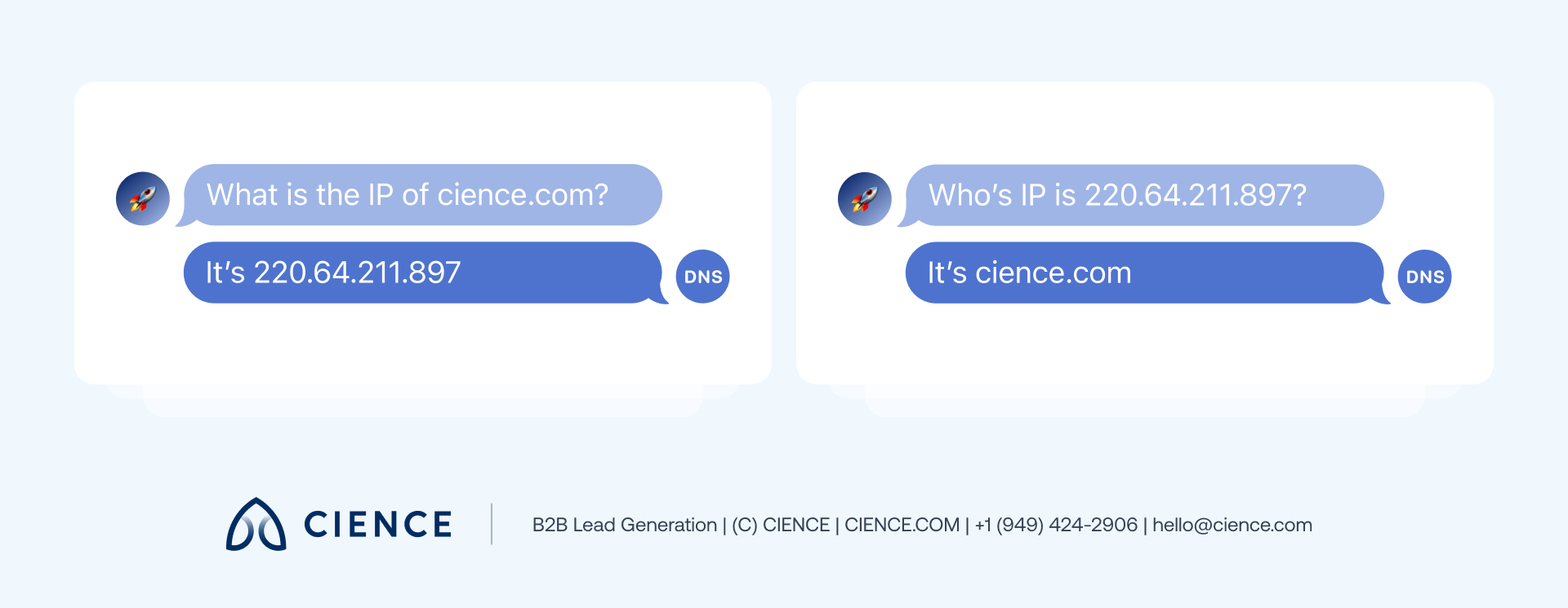
Every internet-connected device has a unique IP address, and a reverse domain name system (rDNS) uses that IP to return the hostname — essentially, the company name behind the visit.
Think of it as a reverse address book: instead of looking up a company to get its IP, you provide the IP and get the company name back. A visitor lands on your website, leaves a trace of their IP, and your tracking tool matches it to a company in real time.
Script
Another method: install a lightweight tracking script on your website that collects visitor information directly. This raw data is then enriched with publicly available information — employee headcount, address, social media profiles, and contact data — to build a complete company profile around each visit.
Website Visitor Tracking FAQs
How do you track website visitors using Google Analytics?
Google Analytics is one of the most accessible tools for website user tracking. Create an Analytics property, add the tracking ID to your website, and within 24 hours you’ll have data including user counts, bounce rates, average session duration, sessions by channel, page views, and goal completions.
Can you see who visits your website?
Normally, no. Without a dedicated tool, you can only identify visitors who voluntarily share their information (email sign-ups, form fills, or live chat interactions). Website visitor tracking tools solve this by matching anonymous IP addresses to company data — so you know which organizations are browsing your site, even before any individual has converted.
Is website visitor tracking GDPR compliant?
It’s supposed to be. The General Data Protection Regulation (GDPR) protects user data privacy with strict requirements. Breaking those rules can result in significant fines, so any tool you use must be GDPR-compliant — with clear privacy, terms, and cookie policies (including an opt-out option) and proper data encryption for safe storage.
What’s the difference between B2B and B2C website visitor tracking?
The fundamentals are the same; the use cases differ. B2B visitor tracking is about identifying specific companies and contacts to pursue with personalized outreach. B2C tracking is primarily statistical — total page views, purchase volume, geographic breakdown — because identifying every individual in a 30,000-visitors-per-minute flow isn’t practical or useful.
What sales funnel stages is website visitor tracking active in?
It’s active from awareness through conversion. At the awareness stage, you can identify which industries respond best to your content and adjust your strategy. At the consideration stage, you can build landing pages specifically for companies that previously visited your blog. At the conversion stage, create alerts so sales gets notified the moment a target account returns to a high-intent page.
What kind of data can I get about my visitors?
Beyond IP and company name, visitor identification tools provide behavioral data: link and button clicks, page visits, visit duration, acquisition channel (organic search, paid, email, referral), and UTM parameters. Some tools offer real-time tracking so your team can act immediately on new high-intent sessions. Pair this with intent data to build a complete picture of buyer readiness before your first outreach touch.
Find Out More About Website Visitor Tracking

Best Website Visitor Tracking Software
There’s a wide variety of website analytics tools available — some provide general traffic stats, others go deeper by tracking user behavior and identifying companies in real time. Below are 9 of the best, organized by use case.
| Tool | Type | Best For |
|---|---|---|
| CIENCE GO Show | B2B Identification | Pipeline generation, ABM, ad retargeting |
| Leadfeeder | B2B Identification | CRM-connected lead scoring |
| Salespanel | B2B Identification | Real-time lead qualification |
| Crazy Egg | Behavior Tracking | A/B testing, heatmaps, UX optimization |
| UserTesting | Behavior Tracking | Usability testing with real users |
| Optimizely | Behavior Tracking | Landing page and experience optimization |
| Google Analytics | Free Analytics | Traffic, demographics, channel attribution |
| Mixpanel | Free Analytics | Behavioral analytics and funnel analysis |
| Hotjar | Free Analytics | Heatmaps, session recording, feedback |
Website Visitor Identification Software
1. CIENCE GO Show
CIENCE GO Show is a visual website visitor tracking platform that identifies B2B companies browsing your site and delivers clean, real-time data — no bots, no ISPs polluting the results. In GO Show, you can segment leads using behavioral and demographic filters and route them directly into outreach workflows.
GO Show supports three main use cases: advertising (remarketing, retargeting, and full reporting), marketing (contact acquisition, full-funnel attribution), and sales (hot lead notifications and account-level activity alerts). It integrates cleanly with other CIENCE data products to deliver a complete outbound pipeline experience.
CIENCE has helped 2,500+ B2B clients across 250+ industries, earning a 4.6/5 rating on Capterra. See how it fits your pipeline →
2. Leadfeeder
Leadfeeder is a website visitor tracking tool that offers source tracking, lead scoring, capture, and segmentation to enhance sales and marketing efforts. Its account-level visitor identification ties every visit back to a company — with CRM integrations, lead warmth scoring, and filtering by industry or company size built in.
3. Salespanel
Salespanel identifies website visitors, tracks their behavior, and assists in lead qualification — all in real time. Its visitor intelligence generates data that powers lead qualification and nurturing workflows, syncing directly with your CRM for immediate action.
User Behavior Tracking Tools
4. Crazy Egg
Crazy Egg is an A/B testing tool that tracks user behavior and lets you test page variants for best-in-class user experience. Features include snapshots, session recordings, heatmaps, traffic analysis, error tracking, and surveys — all in one platform.
5. UserTesting
UserTesting connects you with real people who walk through your website or app on camera, so you can see exactly what they do and how it affects the quality of their experience. Most useful for prototyping, usability testing, and screen activity recording.
6. Optimizely
Optimizely is a website optimization platform that tracks user behavior for web page and landing page performance improvement. It’s part of a broader digital experience platform (DXP) that also includes marketing planning, content management, and feature flag management.
Free Website Tracking Tools
7. Google Analytics
Google Analytics is the go-to free analytics tool for measuring website traffic and identifying your best and worst-performing pages. The free version supports up to 10 million hits per month and lets you segment user demographics, device types, returning vs. new visitors, and channel performance.
8. Mixpanel
Mixpanel is a behavioral analytics tool focused on how and why people engage with your website — surfacing the “why behind the click” to improve user experience and conversion rates. Its free tier covers most early-stage needs.
9. Hotjar
Hotjar analyzes user engagement with heatmaps and session recordings. The Heatmap feature shows visually where users click, scroll, and linger on a page — making it easy to spot conversion bottlenecks and optimize your highest-traffic landing pages.

“Silicon Valley Insight increased monthly appointments by over 500% working with CIENCE — a direct result of identifying and acting on the right accounts.” — Silicon Valley Insight
CIENCE + graph8 pricing: $5,000 one-time GTM system setup, $2,499/mo strategic execution, and the graph8 platform at $499/mo. No long-term contracts. See full pricing →
Whether or not you decide to work with us, you’ll walk away with a clear picture of where your pipeline is leaking and what it would take to fix it.
Get the Most from Website Visitor Tracking
Visitor tracking gives you control over your pipeline: warm leads, behavioral intelligence, and a direct path from anonymous traffic to qualified conversations. When you know who your visitors are, you respond faster, personalize better, and stop leaving intent signals on the table.
For B2B teams running outbound programs or managing data-driven pipelines, layering visitor tracking with intent signals creates a compounding advantage — you’re always working the accounts most likely to convert, not just the ones who fill out a form.

A graph8 company — AI-powered GTM execution across 250+ B2B industries.
graph8 Platform
From $499/mo
Run your own GTM campaigns with AI-powered data, sequences, and analytics.
Start Free — 2,500 Credits No credit card requiredCIENCE Managed
From $2,499/mo
Our GTM teams build and run your outbound campaigns end-to-end.
15-min call · No commitment2,500+ B2B companies served · Month-to-month contracts · See full pricing →