
B2B SaaS delivers cloud-based software to businesses via subscription, eliminating upfront infrastructure costs. The global SaaS market now exceeds $300 billion, with 80% of enterprises already running on or migrating fully to SaaS tools. Key benefits include reduced costs, greater flexibility, scalability, improved security, and automatic updates — all without on-premise hardware.
Last Refreshed: March 2026 with updated statistics and tool information.
B2B SaaS (software-as-a-service) refers to cloud-based software solutions that businesses purchase via subscription to streamline operations, reduce costs, and scale without on-premise infrastructure. The B2B SaaS market is booming, and it’s no wonder the advantages are hard to ignore. From reduced costs to increased flexibility, there are plenty of reasons to switch to SaaS. And with 80% of businesses now running on or actively migrating all their systems to SaaS, it’s clear this shift has arrived.
From Thomas Cornelius, Founder & CEO, graph8: “B2B SaaS compressed the barrier to great GTM infrastructure — but software alone doesn’t create pipeline. The companies scaling fastest pair modern SaaS tools with the operational discipline to actually extract value from them.” If you’re new to the world of B2B SaaS, this guide is for you. We’ll cover everything you need to know about B2B SaaS, from the basics of what it is to the benefits of using SaaS systems. If you’re considering a move to SaaS, you’ll find the information you need to make an informed decision about whether B2B SaaS is right for your business.
What Is B2B SaaS?
B2B SaaS (software-as-a-service) refers to companies that provide software services to businesses via the Internet. These products enable companies to operate more efficiently using advanced cloud-based services to enhance sales performance.
Let’s say you’re a business that wants to create a sales call plan template for your team. In the past, you would have needed to purchase a customer relationship management (CRM) system and then install it on your servers. You would then need to set up the system and train your team on how to use it. With B2B SaaS, you can simply sign up for an online account with a service provider and start using the software immediately.
What Is B2B SaaS vs. B2C SaaS?
B2B SaaS is software that is designed specifically for businesses to use whereas B2C SaaS is designed for consumers. Some of the key differences include:
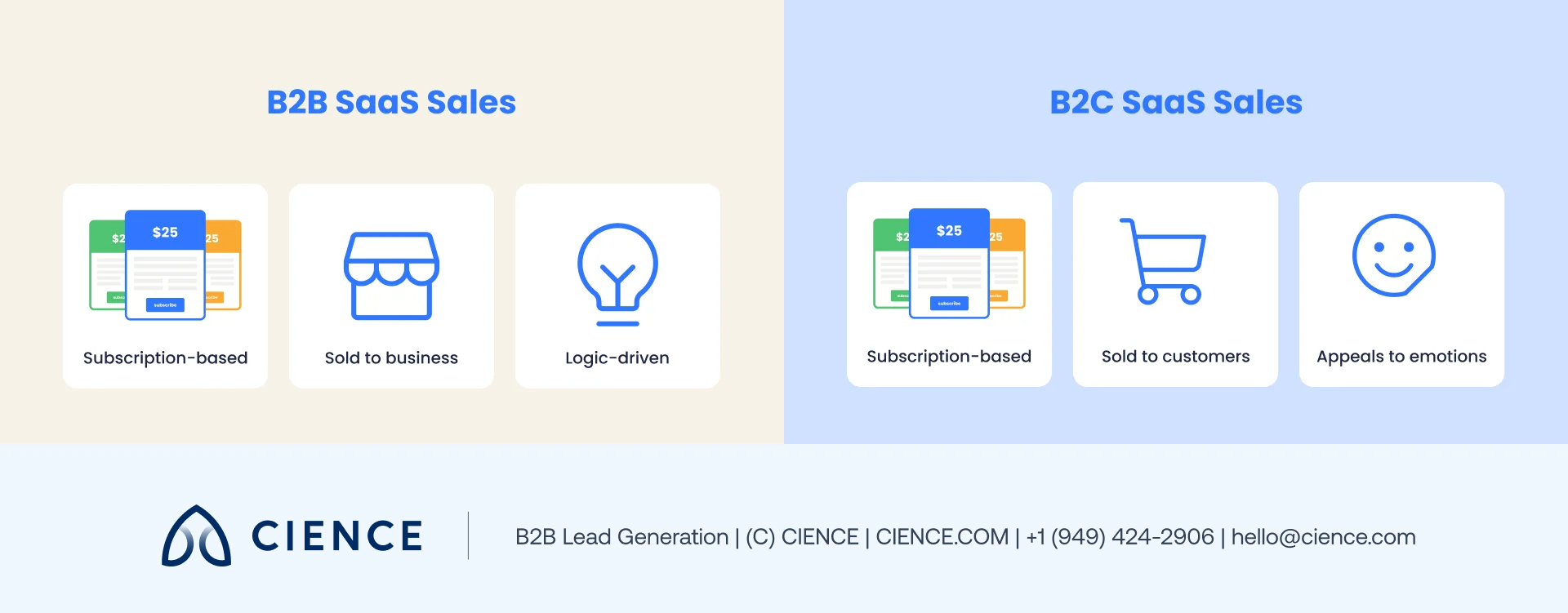
1. B2B SaaS software is usually more complex.
B2B software needs to be feature-rich and able to handle complex processes. For example, a B2B sales platform will need to be able to track sales data, manage customer relationships, and generate reports. In contrast, B2C SaaS may only require a simple e-commerce platform.
2. B2B SaaS is designed for collaboration.
B2B software needs to be designed for team use, with features such as lead management, permissions, and comments. This allows teams to work together on projects, regardless of location. In contrast, B2C software is designed for individual use and doesn’t usually include collaboration features.
3. B2B SaaS sales are usually more logic-driven.
Purchasing decisions for B2B SaaS are usually made by a team who will consider the logic of the purchase. They’ll look at things like pricing, features, and whether the software fits with their existing systems. In contrast, B2C software is often purchased on impulse, based on emotions such as wanting the latest and greatest gadget.
Discover 10 best ways to increase B2B sales.
B2B SaaS Market & Growth
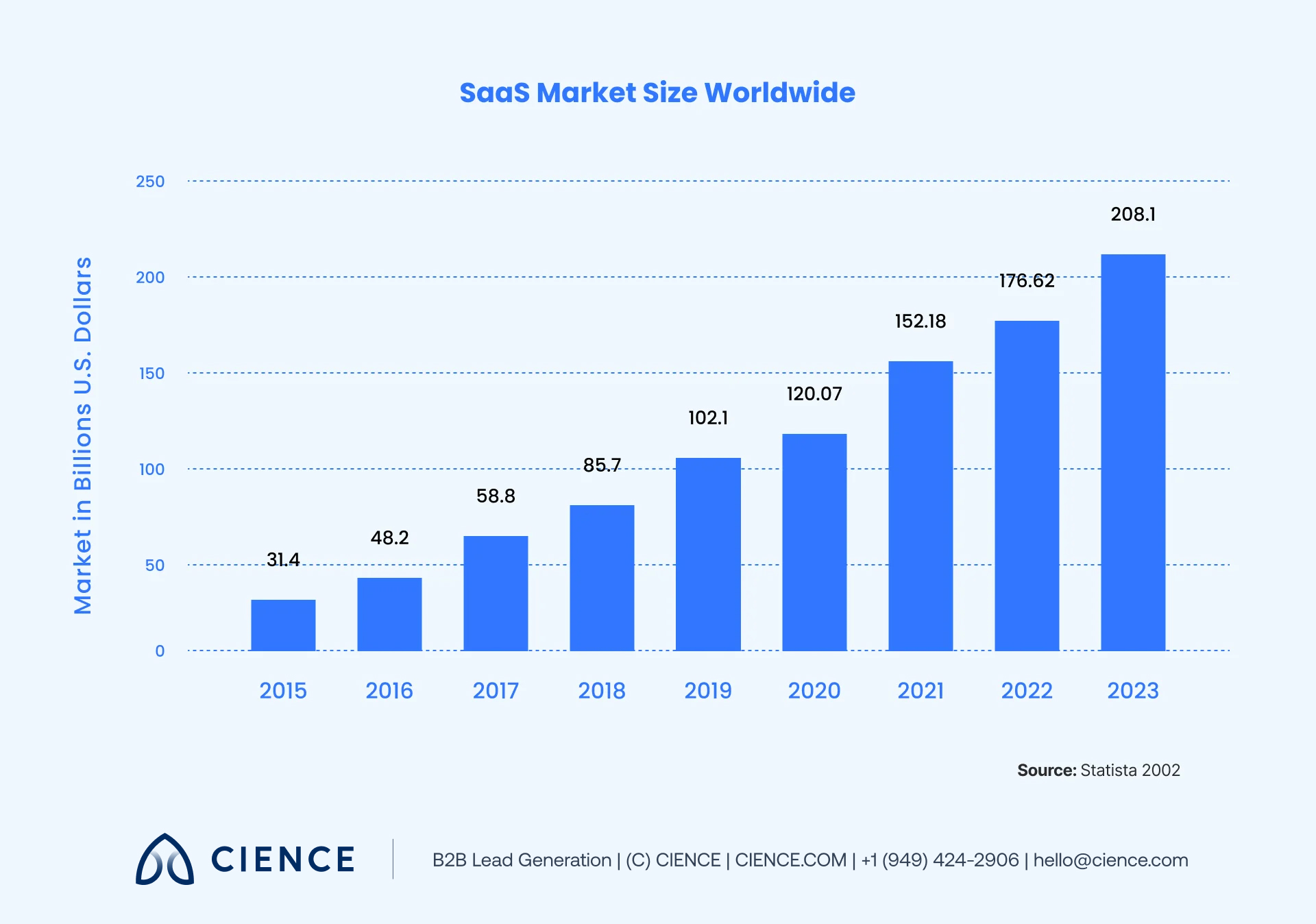
The global B2B SaaS market is growing rapidly. With this growth, the importance of SaaS SEO in enhancing visibility and driving user acquisition becomes paramount. According to Statista, the global SaaS market surpassed $200 billion in 2023 and is now projected to exceed $300 billion by 2026 — a trajectory that makes early adoption a competitive necessity, not a nice-to-have.
There are several factors driving this growth, including:
Artificial intelligence
Businesses are using AI tools to accomplish tasks more quickly and efficiently. From customer service to marketing, AI is being used in a variety of ways to improve business operations.
With a SaaS-based CRM platform, you can use AI to automate tasks such as lead generation and customer segmentation. This can free up your sales team to focus on other tasks, and it can also help you to improve your marketing campaigns. For specialized customizations or integration projects, outsourcing software development can be a practical approach to modify AI functionalities to align with your business’s specific requirements.
Replacement of on-premise technology
More and more businesses are replacing their on-premise technology with SaaS solutions. This is because SaaS is more cost-effective, flexible, and scalable than traditional software systems. For example, using B2B lead generation software can help you to generate high-quality leads more effectively than using a traditional marketing campaign.
Rise in cloud computing
The global increase in using mobile devices such as laptops, tablets, and smartphones has driven the need for cloud-based solutions. Users expect to be able to access their data and applications from anywhere. With a SaaS system, you can meet this demand by providing your teams with a cloud-based solution that they can access from any device.
“Over 60% of our sales during our first six months came as a result of CIENCE.” — Casey Griswold, Founder, Armatic
If your outbound is producing diminishing returns despite more tools and more reps, the problem isn’t execution — it’s architecture.
5 Top Benefits of B2B SaaS
Now that we’ve covered the basics of B2B SaaS and what’s behind its growth, let’s take a look at five key benefits of using SaaS systems for your business:
1. Reduced costs
One of the biggest advantages of B2B SaaS is that it can help businesses to reduce their costs. When you purchase a traditional software system, you need to pay for the initial license fee, as well as the cost of installation and setup. With SaaS, there are no upfront costs—you simply pay a monthly or yearly subscription fee.
This can be a big advantage for small businesses or start-ups that may not have the large upfront capital to invest in a traditional software system. SaaS systems also offer a pay-as-you-go model, which means you only pay for what you use.
According to an UpCity study, 27% of small businesses have increased their business software budget in 2022, an upsurge in large part due to the pandemic. But B2B SaaS can be a more cost-effective option than purchasing traditional software, which you may not use to its full potential.
2. Increased flexibility
An estimated 37% of companies adopt cloud-based systems for their flexibility. With traditional models, you need to install the software on your own servers, which can be a complex and time-consuming process. With SaaS, you can simply start using the software right away. This means you can get up and running quickly without having to go through a lengthy setup process.
3. More scalability
According to a Deloitte global technology leadership study, 70% of CIOs are attracted to cloud-based SaaS for its agility and scalability. SaaS systems are designed to be scalable, which means they can grow and change as your business grows. For example, if you need to add more users to a SaaS system, you can simply add them to your account. This makes it easy to scale up or down, depending on your needs. If you are monitoring a cloud-based app, you will also need a scalable Prometheus architecture.
4. Improved security
When you use SaaS, your data is stored in the cloud, which means it is more secure than storing it on your servers. When you store your own data, it’s at risk of being lost or stolen if your servers are hacked. However, when you store your data in the cloud, it is hosted by a SaaS provider that has strict security measures in place to protect your passwords and data. In this way, you’ll get all the benefits of increased scalability, improved cyber and physical security, and reduced costs to help run your business.
5. Automatic updates
Another advantage of B2B SaaS is that you automatically receive updates. This means you always have the latest version of the software without having to install updates manually. You no longer have to wait for the software vendor to release an update and then install it on your own. This can be a time-consuming process, and if you don’t install the updates, you could be at risk of security vulnerabilities.
Find the Right B2B SaaS Solutions
Whether you are looking for B2B data solutions, sales intelligence tools, or managed outbound services for your business, B2B SaaS may be the right choice for you. You’ll get all the benefits of increased scalability, improved security, and reduced costs to help run your business.
With such rapid growth, now is the perfect time to get involved in this exciting market. CIENCE has helped 2,500+ clients across 250+ industries implement SaaS-powered outbound and data systems — rated 4.6/5 on Capterra. Take advantage of B2B SaaS solutions to manage your business effectively.
Grow Your Business with CIENCE
“The CIENCE team is truly a wonderful group to work with. They are industry experts and executed our plan to a T. We’ve seen a legitimate impact to our business from their effort, and we consider them a valuable partner to our organization.” — Vince Velasco, Head of Customer Experience, Emotive
CIENCE + graph8 pricing: $5,000 one-time GTM system setup, $2,499/mo strategic execution, and the graph8 platform at $499/mo. No long-term contracts. See full pricing →
Whether or not you decide to work with us, you’ll walk away with a clear picture of where your pipeline is leaking and what it would take to fix it.
Frequently Asked Questions
What is the difference between B2B SaaS and traditional software?
Traditional software requires upfront license fees, on-premise installation, and manual updates managed by your IT team. B2B SaaS is cloud-based, subscription-priced, and automatically updated by the provider. SaaS eliminates hardware costs and allows teams to access the software from any device, anywhere, with no installation required.
How do you evaluate the right B2B SaaS solution for your business?
Start by defining your core requirements, budget, and integration needs with existing systems. Compare at least 3 vendors on pricing, features, scalability, security certifications, and customer support. Request free trials or demos, and check independent reviews on G2 or Capterra. Prioritize solutions that offer API integrations with your CRM and existing tech stack.
Is B2B SaaS secure enough for enterprise data?
Leading B2B SaaS providers invest heavily in security, often exceeding what most companies can achieve on-premise. Look for SOC 2 Type II certification, encryption at rest and in transit, multi-factor authentication, and regular third-party security audits. Cloud providers like AWS and Azure maintain physical and network security at enterprise scale.

A graph8 company — AI-powered GTM execution across 250+ B2B industries.
graph8 Platform
From $499/mo
Run your own GTM campaigns with AI-powered data, sequences, and analytics.
Start Free — 2,500 Credits No credit card requiredCIENCE Managed
From $2,499/mo
Our GTM teams build and run your outbound campaigns end-to-end.
15-min call · No commitment2,500+ B2B companies served · Month-to-month contracts · See full pricing →