
SDRs who use structured outbound systems — targeted lists, multichannel sequences, and AI tools — generate 50% higher conversion rates than inbound-only teams. The 10 strategies in this guide cover everything from account research and list segmentation to personalization, content leverage, data-driven iteration, and the AI tools that are reshaping what a productive SDR day looks like in 2026.
From Daniel Conn, GTM Strategist, graph8: “Most SDR teams think they have a volume problem. They don’t — they have a targeting problem. A list of 500 perfectly matched prospects will outperform 5,000 generic contacts every time. Quality of signal beats quantity of noise.”
Last Refreshed: March 2026 — updated statistics, AI tool recommendations, and internal links.
SDR lead generation is the systematic process of sales development representatives identifying, contacting, and qualifying potential buyers through outbound channels like cold calls, emails, LinkedIn, and ads.
As a sales development representative (SDR), optimizing outbound lead generation efforts is essential for success. According to a recent report from Demand Gen, companies using outbound strategies to generate leads experience a 50% higher conversion rate than those using inbound strategies alone. CIENCE has applied these principles across 2,500+ clients in 250+ industries, earning a 4.6/5 rating on Capterra.
SDRs are tasked with the critical job of initiating contact with potential customers and building relationships with them. This is typically done through an outbound campaign including digital ads, cold calls, cold emails, and LinkedIn prospecting—in coordinated multichannel sequences.
For SDRs to be successful, they must be able to optimize their outbound plan to effectively generate high-quality leads. This article will discuss the ten best tips SDRs can use to maximize outbound lead generation efforts.
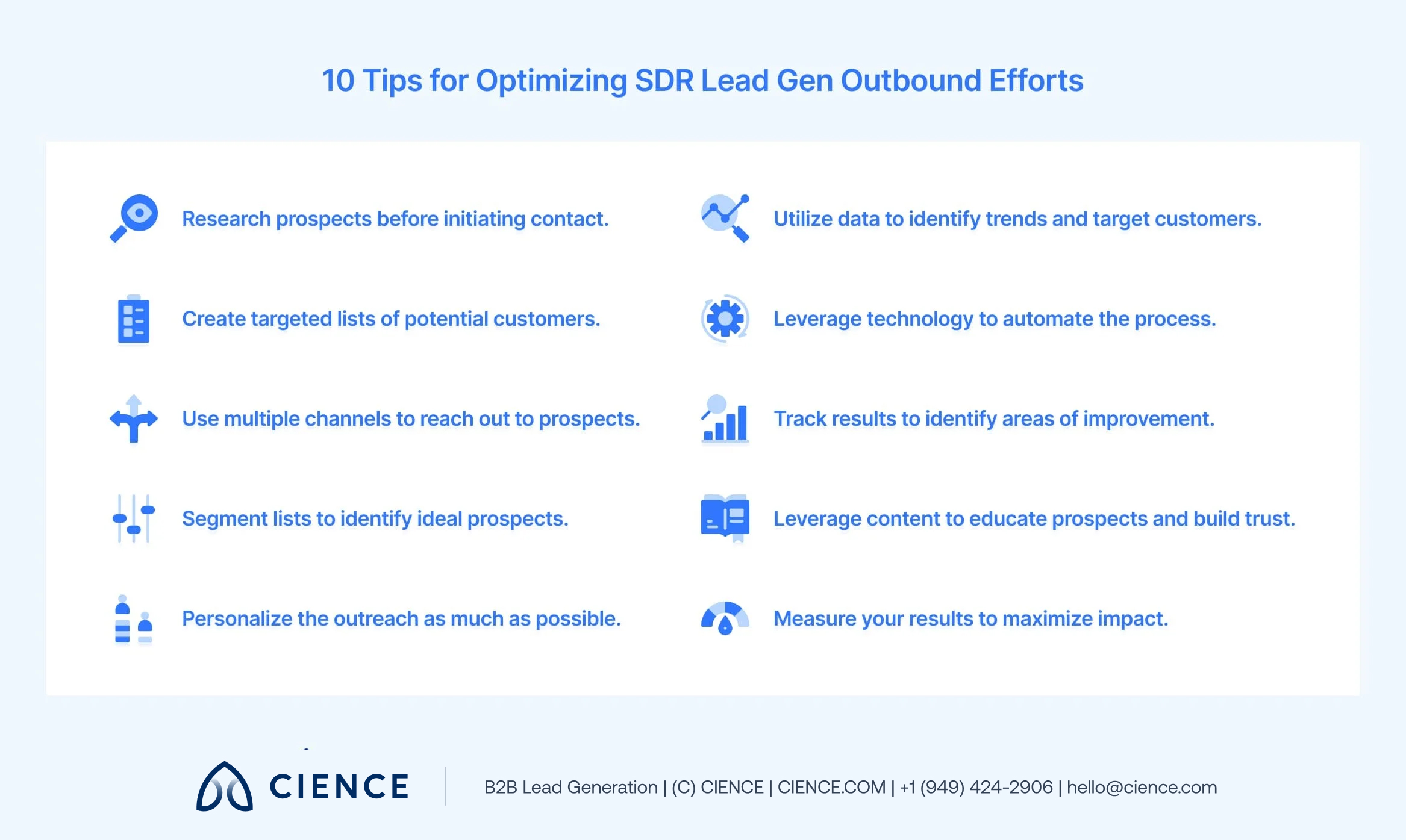
10 Tips to Maximize SDR Lead Generation
Below are ten top strategies that SDRs can use to optimize lead generation. At CIENCE, we practice these tenets daily with hundreds of our own outbound SDRs. By implementing these tips, SDRs can level up their outreach and increase the effectiveness of future lead generation campaigns.
1. Do your homework.
The key to successful lead generation is having strong relationships with prospects. SDRs should strive to “show me you know me” to build relationships with potential customers before they initiate contact. This can be done by researching the company, learning about the industry, and identifying common connections. This will help SDRs create a more personalized and thus more effective outreach.
Effective prospect research includes reviewing recent company news, understanding the prospect’s role and responsibilities, and identifying shared connections or mutual interests before sending the first message.
2. Create targeted lists.
Creating targeted lists of potential customers is a crucial step in optimizing lead generation efforts. SDRs should focus on creating lists of prospects that are likely to be interested in their product or service. This will help to ensure that the outreach is more effective and that the leads generated are of a higher quality.
Targeted lists can and should also be prioritized and stack-ranked by account-level segments like industry, geography, or size of the company. CIENCE’s B2B data platform makes it possible to build highly targeted lists filtered by firmographic, technographic, and intent signals.
3. Use multiple channels.
To maximize lead generation strategies, SDRs should use a variety of channels to reach out to prospects. This could include cold calls, emails, advertising, and even social media channels. By using multiple channels, SDRs will be able to reach more prospects and increase the chances of generating leads.
Channels should be used in combination with one another and in the same sequence — a series of coordinated touches designed to land a meeting and start a sales cycle. Research shows that multichannel sequences combining email, phone, and LinkedIn generate up to 287% higher engagement than single-channel outreach.

4. Create segmented lists.
Once SDRs have created a targeted list of prospects, they should segment the list into smaller, more manageable segments. This will make it easier to personalize the outreach and track the results. Segmenting lists will also make it easier to identify which prospects are the most likely to convert into leads.
Prioritizing segments by the department of prospects and title cluster of specific contacts (e.g., CFOs, directors of IT, marketing managers) is also helpful in producing scalable yet high-quality outreach.
5. Personalize outreach.
SDRs should strive to personalize their outreach as much as possible. This could include using a prospect’s name in the subject line, referencing content that they have created or expressed interest in, or tailoring the message to the individual’s current business challenges. Personalizing the outreach will make it more effective and increase the chances of generating leads.
For tactical guidance on writing cold emails that get replies, see our guide on cold email subject lines — even small changes in framing can double open rates.
6. Produce meaningful content.
Content can be a powerful tool for SDRs to generate leads. This content can be used to educate prospects on a product or service, build trust and relationships, and even convert leads into customers. SDRs should leverage content to boost their outbound plan.
Some of the most effective content strategies share case stories with lookalike prospects to demonstrate social proof and also socialize how your company has worked successfully with organizations like theirs in the past. For example, Mandolin tripled their weekly meetings booked by pairing targeted outbound with case study assets matched to each prospect segment.
7. Track results.
SDRs must track their results and analyze the data with the intent of ABO (always be optimizing). This will help them to identify areas where they can improve and focus their efforts. Tracking results will also help SDRs to identify which channels and strategies are generating the most leads.
Key metrics to monitor include: reply rate, meeting booked rate, show rate, and pipeline generated per SDR. Use your sales pipeline metrics as the true north star — activity metrics alone don’t capture what’s actually working.
8. Leverage technology.
SDRs should leverage technology to streamline their outbound efforts. This includes automation tools to speed up processes, CRM systems to track interactions, and analytics to gain insights into campaign performance. Increasingly, AI SDR tools are becoming essential, helping reps prioritize leads, automate follow-ups, and optimize outreach strategies with predictive insights. These tools free SDRs from repetitive tasks, allowing them to focus on more meaningful interactions that drive conversions.
From Quincy Berg, SDR Operations Lead, CIENCE: “The SDRs who outperform aren’t necessarily the ones making the most calls — they’re the ones using data and tooling to spend their time on the right accounts. AI helps separate the signal from the noise.”

9. Utilize data.
B2B contact data is a critical tool to optimize outbound for SDRs. Data can help SDRs to identify trends, target potential customers, and track results. Leveraging data will help SDRs to better understand their prospects and to make better decisions when it comes to their outbound strategies.
Data quality matters more than data volume. A contact list with accurate titles, direct dials, and verified emails will outperform a bloated list of stale records. CIENCE’s sales intelligence tools are built to give SDRs verified, enriched contacts — not just raw records.
10. Measure and maximize your impact.
If your outbound is producing diminishing returns despite more tools and more reps, the problem isn’t execution — it’s architecture.
Once you’ve implemented a lead generation strategy, it’s important to measure your results. Analyze the data to identify what’s working and what needs improvement. Make adjustments as necessary and continue to test new strategies to maximize your impact.
Silicon Valley Insight increased monthly appointments by over 500% after implementing a structured multichannel SDR sequence with CIENCE — moving from ad hoc outreach to a repeatable, measurable system.
CIENCE + graph8 pricing: $5,000 one-time GTM system setup, $2,499/mo strategic execution, and the graph8 platform at $499/mo. No long-term contracts. See full pricing →
Whether or not you decide to work with us, you’ll walk away with a clear picture of where your pipeline is leaking and what it would take to fix it.
BigBox Lighting scaled to 600+ qualified leads per month using a CIENCE-managed outbound program — proof that with the right system, volume and quality don’t have to be a tradeoff.
Frequently Asked Questions
How many leads should an SDR generate per day?
Most SDRs are expected to generate 10–15 qualified leads per day through a mix of cold calls, emails, and social touches. The exact number depends on the industry, deal size, and outreach channels used. High-performing SDRs at companies like CIENCE often exceed these benchmarks by using targeted lists and multichannel sequences.
What is the best channel for SDR lead generation?
No single channel outperforms all others consistently. Research shows that multichannel outreach combining email, phone, and LinkedIn generates the highest response rates. Companies using 3+ channels in their sequences see up to 287% higher engagement compared to single-channel approaches.
How long does it take for an SDR to ramp up?
The average SDR ramp time is 3–6 months before reaching full productivity. Companies with structured onboarding programs that include role-playing, call shadowing, and mentorship can reduce this to 2–3 months. Investing in CRM training and AI-powered sales development methodologies also accelerates the learning curve.
Level Up Your SDR Lead Generation
Lead generation is a crucial part of any sales and marketing strategy, and SDRs play a key role in this process. By leveraging the strategies outlined above, your SDRs can make the most of their lead generation efforts. With the right tactics and the right tools, your team can generate high-quality leads and increase conversions.

A graph8 company — AI-powered GTM execution across 250+ B2B industries.
graph8 Platform
From $499/mo
Run your own GTM campaigns with AI-powered data, sequences, and analytics.
Start Free — 2,500 Credits No credit card requiredCIENCE Managed
From $2,499/mo
Our GTM teams build and run your outbound campaigns end-to-end.
15-min call · No commitment2,500+ B2B companies served · Month-to-month contracts · See full pricing →