
Enterprise prospecting targets large organizations with high ACVs and 6-10 decision-makers per deal. Sales cycles run 6+ months, and each stakeholder brings 4-5 objections. This guide covers 5 data-driven strategies that help teams build the relationships needed to close enterprise contracts.
Last Refreshed: March 2026 with updated statistics and tool information.
Enterprise prospecting is the process of identifying and engaging high-value potential clients at large organizations, where sales cycles run 6+ months and 6-10 decision-makers are involved in each buying decision.
From Thomas Cornelius, Founder & CEO, graph8: “Enterprise deals aren’t won through volume — they’re won through precision. The teams closing the biggest contracts treat their prospect intelligence as a competitive moat, not a spreadsheet. Build the system first; the deals follow.”
An average B2B prospect receives 120+ emails every day. It takes roughly eighteen dials to connect with them and five follow-ups to make a sale. When you’re targeting large enterprises, multiply those numbers — and your strategy needs to match.
Enterprise prospecting isn’t simply harder than standard sales prospecting. It’s fundamentally different. It requires deeper research, longer relationship-building, and a multi-stakeholder approach that most SMB teams rarely need to master.
What Is Enterprise Prospecting?
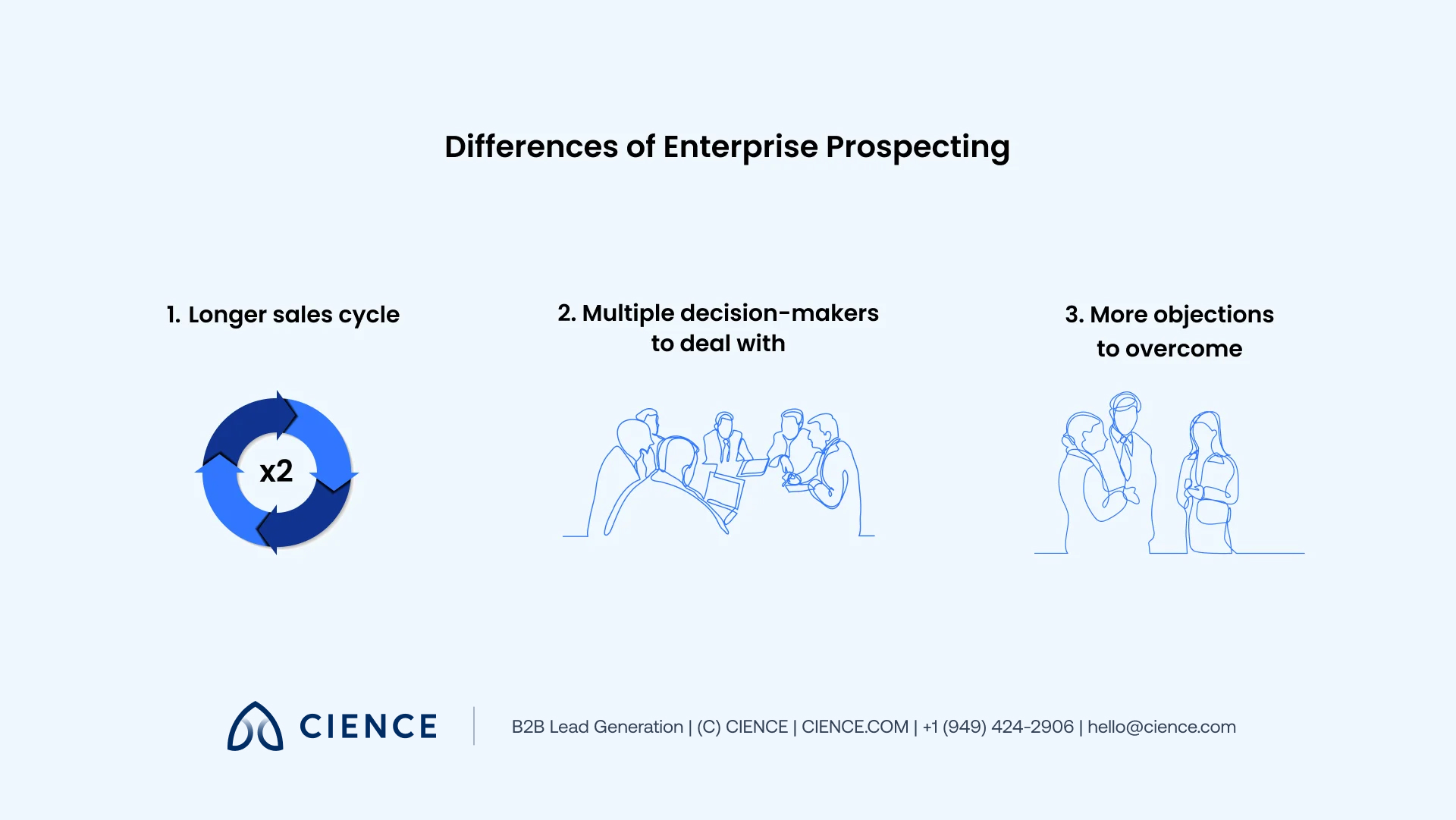
Enterprise prospecting is sales prospecting at scale — identifying high-ACV potential clients among large organizations and building the right pipeline to close them. Unlike SMB prospecting, it has three defining characteristics:
1. Sales cycles are longer.
In SMB prospecting, the average sales cycle takes about three months. With large enterprises, this process takes at least six months — often 12–18 months for complex solutions. The extended timeline is driven by procurement processes, security reviews, and the need to achieve consensus across departments. Investing in enterprise prospecting requires patience, but the ACV of closed deals makes it worthwhile.
2. The number of decision-makers is larger.
On average, B2B organizations have six to ten decision-makers involved in the buying process. In SMB prospecting, a single “yes” closes the deal. With enterprise prospecting, you’re managing a buying committee — and each stakeholder has different priorities, objections, and information needs.
3. More objections need to be addressed.
Each decision-maker gathers four to five pieces of information about your company before raising concerns. With 6-10 stakeholders in the room, that’s 24–50 potential objections per deal. Preparation is everything. The more thoroughly you’ve researched each stakeholder’s role and pain points before entering the conversation, the better your outcome.
5 Best Tips for Successful Enterprise Sales Prospecting
CIENCE has worked with 2,500+ B2B clients across 250+ industries — including enterprise accounts at Okta, Wrike, and Shutterstock. Here are five strategies that consistently move enterprise pipeline:
1. Find a balance between the human and tech approaches.
Outbound automation is table stakes now — according to Salesforce, 81% of businesses use automation in some capacity. For enterprise prospecting, the balance between human touch and technology determines whether you build relationships or generate noise.
If your team is dialing one number at a time or sending emails manually, you’re operating below competitive baseline. Parallel dialing and email automation free your reps to do the work that actually wins enterprise deals: value-adding conversations.
Nobody pays SDRs to dial a phone. Secure your email deliverability, ensure your calls are answered, and use technology to maximize the number of meaningful conversations — not just raw touchpoints.
2. Focus on context, not content.
Research shows that 90% of the information we retain is visual. Yet cold email remains one of the most effective outreach channels — because the context of the message matters more than its content.
The human brain translates written words into thoughts and associations. A well-crafted email builds the emotional context that secures enterprise consideration. As Morgan J. Ingram famously put it: “If content is king, context is god.”
Build context through visual elements — images, short videos, relevant industry examples — and through personalization that speaks directly to each stakeholder’s role and pain points. Multi-threading across the buying committee works best when each message feels tailored to the individual recipient, not mass-broadcast to a list.
3. Collect and analyze data.
Enterprise sales prospecting requires both sales skill and research discipline. Identifying your decision-makers is one thing; understanding their specific pain points is another. The strategy that consistently works is collecting high-quality, relevant data about your prospect before you ever make contact.
This means analyzing company news triggers, job change signals, technology stack data, and spending intent. Use AI for sales prospecting to surface patterns at scale — AI tools identify accounts most likely in an active buying cycle, allowing your team to prioritize the highest-probability targets.
Owning deep account intelligence improves your ability to build relationships based on genuine empathy and context. No cold calling script can substitute for a thorough understanding of your prospect’s business situation.
Build your enterprise target account list →
4. Focus on building relationships, not closing deals.
The biggest mistake in enterprise sales prospecting is pitching too early. With enterprises, you’re building long-term opportunities across a buying committee. Your goal at first contact isn’t to close — it’s to earn a second conversation.
Build your outreach around the prospect: their business challenges, their industry pressures, their internal priorities. Justin Michael, author of Tech-Powered Sales, once shared that if he’s on a sales call for fifteen minutes, fourteen of those minutes belong to the prospect talking.
Multi-threading — engaging multiple stakeholders simultaneously across email, phone, and LinkedIn — is the key to enterprise pipeline velocity. When you have champions in multiple departments, buying committee consensus happens faster and deal risk decreases.
Listen to our enterprise sales development podcast →
5. Be brief, be brilliant.
First impressions define enterprise deals. When you finally get a meeting with a decision-maker, you have roughly eight seconds of full attention to provoke genuine interest. What you say in those eight seconds determines whether the conversation continues or ends there.
Craft your opener around the prospect’s specific situation. Highlight value concisely, invite dialogue, and resist the urge to over-pitch. When you’re in the room, keep your pitch precise: anchor every point in real data, relevant case studies, and results you’ve driven for comparable clients.
“They definitely supersede our internal capabilities.” — Candice Long, Marketing Director, Learning Ally
Enterprise pipeline isn’t built through spray-and-pray. It’s built through account intelligence, multi-stakeholder relationships, and a prospecting system that compounds over time.
CIENCE + graph8 pricing: $5,000 one-time GTM system setup, $2,499/mo strategic execution, and the graph8 platform at $499/mo. No long-term contracts. See full pricing →
Whether or not you decide to work with us, you’ll walk away with a clear picture of where your pipeline is leaking and what it would take to fix it.
Frequently Asked Questions
What is the difference between enterprise prospecting and SMB prospecting?
Enterprise prospecting targets large organizations with high annual contract values, involving 6-10 decision-makers and sales cycles of 6+ months. SMB prospecting focuses on smaller companies with shorter 3-month cycles, typically requiring approval from just 1-2 stakeholders. The core difference is complexity: enterprise deals require multi-stakeholder management, deeper research, and sustained relationship-building before a decision is ever made.
How long does an enterprise sales cycle typically take?
Enterprise sales cycles run a minimum of 6 months and frequently extend to 12-18 months for complex solutions. The extended timeline is driven by multiple stakeholders, procurement processes, security reviews, and the need for consensus across departments. Plan your pipeline accordingly — deals started today often close next year.
What are the biggest challenges in enterprise prospecting?
The top challenges are navigating 6-10 decision-makers who each bring 4-5 objections, maintaining deal momentum across long sales cycles, and personalizing outreach at scale without losing quality. Successful enterprise prospecting requires balancing automation tools with genuine relationship building and deep account research. Teams that solve for multi-threading — engaging multiple stakeholders simultaneously — see the most consistent results.
Build Your Enterprise Prospecting System
Enterprise contracts are the most valuable deals in B2B sales. They bring large revenues, brand recognition, and the credibility that attracts additional enterprise clients. At the same time, winning them requires a fundamentally different approach — more methodical, more patient, and more personalized than SMB prospecting.
“True professionals, reliable.” — Wrike, Project Management
The five strategies above — technology balance, contextual messaging, data intelligence, relationship building, and concise pitching — form the foundation of an enterprise prospecting system built to scale.
CIENCE has helped 2,500+ companies, including Okta, Wrike, and Shutterstock, build pipeline with enterprise-grade accounts. See how we do it →

A graph8 company — AI-powered GTM execution across 250+ B2B industries.
graph8 Platform
From $499/mo
Run your own GTM campaigns with AI-powered data, sequences, and analytics.
Start Free — 2,500 Credits No credit card requiredCIENCE Managed
From $2,499/mo
Our GTM teams build and run your outbound campaigns end-to-end.
15-min call · No commitment2,500+ B2B companies served · Month-to-month contracts · See full pricing →