
Sales prospecting is the process of identifying and qualifying potential customers through research, outreach, and follow-up — and 40% of sales reps say it's the hardest part of their job. Companies using structured prospecting systems generate 3x more qualified pipeline than those relying on ad hoc outreach. This guide covers 12 prospecting methods, a 7-step process, and 5 actionable tips to build pipeline faster.
Last Refreshed: March 2026 with updated statistics and tool information.
Sales prospecting is the process of identifying, researching, and qualifying potential customers through outreach methods like cold calling, email, social selling, and networking. 40% of sales reps say prospecting is the hardest part of their job, yet it remains the single most important activity for building a healthy sales pipeline.
From David Dulany, Founder, Tenbound (a graph8 company): “Most reps don’t fail at prospecting because they lack effort — they fail because they haven’t defined who they’re actually trying to reach. Nail your ICP before you touch your sequence, and the rest of the process becomes dramatically easier.”
This guide covers the core prospecting methods, actionable tips, and real-world examples that SDRs and sales teams use to generate leads and convert them into qualified opportunities.
What Is Prospecting?
Prospecting is the process of identifying potential customers or clients for a business or organization. It involves researching and identifying individuals or companies that may have a need for the products or services offered by the business and reaching out to them to establish a business relationship.
In sales, prospecting is typically the first step in the sales prospecting process, where sales representatives research and identify potential customers and reach out to them to generate interest in their products or services. Prospecting can involve various methods, such as cold calling, email marketing, direct mail, social media outreach, and networking events.
The main goal of prospecting in sales is to develop a massive yet accurate database of likely customers so marketers can have an easier time nurturing leads and filtering these prospects. Once these prospects are qualified, sales professionals take over to try to close those deals.
The prospecting process categorizes website visitors, followers, and potential customers who have shown some interest in your product or brand into the following groups:
Leads
These individuals and organizations may require a solution like the one you offer but aren’t necessarily aware of your brand or value proposition. The mission is to raise brand awareness and familiarity with your business to discover if your solution fits their needs.
Prospects
Prospects have confirmed their interest in buying from you at some point. For B2B prospecting, it is extremely important to discover the real urgency to access a solution for potential buyers, the decision-makers, and if the budget is solvent enough for your product.
Customers
To put it in simple words, a customer is a prospect who has already purchased one of your products or services. Upselling prospect strategies can be set in motion to further increase the size of the deals that both parties agreed on at a certain point.
How Does Sales Prospecting Work?
The prospecting process involves several key steps:
- Research: Identify potential prospects by researching companies and individuals that fit your ideal customer profile.
- Qualification: Determine whether the prospect has a need for your product, the authority to make decisions, and the budget to purchase.
- Outreach: Engage with the prospect through various channels like phone calls, emails, or social media.
- Follow-Up: Continue to nurture the relationship by providing valuable information and addressing any concerns.
- Conversion: Once the prospect is sufficiently interested, hand them off to the sales team to close the deal.
The Importance of Prospecting in Sales
Prospecting is a critical component of the sales process with 40% of sales reps saying it’s the most difficult part of the job. Yet, when done correctly, it becomes a highly effective way to identify and engage potential customers and build a pipeline of leads.
Accurate prospecting in sales involves identifying potential clients, seeking out information about them, and then determining whether they are likely to make a purchase. By taking the time to research and prospect, you can identify individuals and businesses that are most likely to make a purchase and then tailor your messaging accordingly.
Prospecting is also essential from a time management perspective as it allows you to focus your efforts on the most promising prospects, rather than wasting time on leads that are unlikely to convert. In addition, prospecting can help to identify potential customers as a good fit who may not have otherwise been aware of your product or services.
By investing in effective prospecting techniques, sales teams can maximize their resources and increase their chances of making sales. CIENCE has helped 2,500+ clients across 250+ industries build repeatable prospecting systems — earning a 4.6/5 rating on Capterra.
Types of Prospecting in Sales
Prospecting in sales can be broadly categorized into two main types:
- Outbound Prospecting: This involves actively reaching out to potential customers. Methods include cold calling, cold emailing, social media outreach, and direct mail. Outbound prospecting is proactive and often requires a higher level of research and customization to engage prospects effectively.
- Inbound Prospecting: In contrast, inbound prospecting focuses on engaging with potential customers who have already shown interest in your products or services. This can include following up with website visitors, responding to inquiries from marketing campaigns, and engaging with leads generated from content marketing efforts. Inbound prospecting is generally seen as more efficient since the prospect has already expressed some level of interest.
Prospecting vs. Lead Generation: A Comparison
While prospecting and lead generation are closely related, they serve different purposes in the sales process. Here’s a comparison of the two:
| Prospecting | Lead Generation | |
|---|---|---|
| Definition | The process of identifying and reaching out to potential customers. | The process of attracting and converting potential customers into leads. |
| Focus | Targeted outreach to specific individuals or companies. | Broad marketing efforts to attract interest from a wider audience. |
| Approach | Direct and personalized communication. | Indirect, often using content marketing, SEO, and advertising. |
| Timeframe | Typically a shorter, more immediate process. | Longer-term strategy, often involving nurturing over time. |
| Outcome | Identification of qualified prospects ready for sales engagement. | Generation of leads that require further qualification. |
If your outbound is producing diminishing returns despite more tools and more reps, the problem isn’t execution — it’s architecture.
Who is Involved in Sales Prospecting?
Prospecting is typically done by sales representatives, but it can also involve marketing teams, business development specialists, and even company executives in some cases. In smaller organizations, the responsibility might fall on the business owner or a small sales team.
- Sales Representatives (SDRs): Often the primary prospectors, responsible for identifying and qualifying potential customers.
- Business Development Representatives (BDRs): Focused on finding new business opportunities and setting up meetings for the sales team.
- Marketing Teams: Involved in inbound prospecting by generating leads through content marketing, SEO, and social media campaigns.
- Executives: In high-stakes sales or niche markets, executives might engage in prospecting to build strategic relationships.
Most Effective Prospecting Techniques
As usual, the B2B prospecting efforts have some meaningful variations from the B2C approach. The prospecting game for B2B marketing and sales reps demands supplying the sales pipeline with only the best-qualified leads. Here are some successful prospecting methods that tend to hit the mark:
Cold phone calls
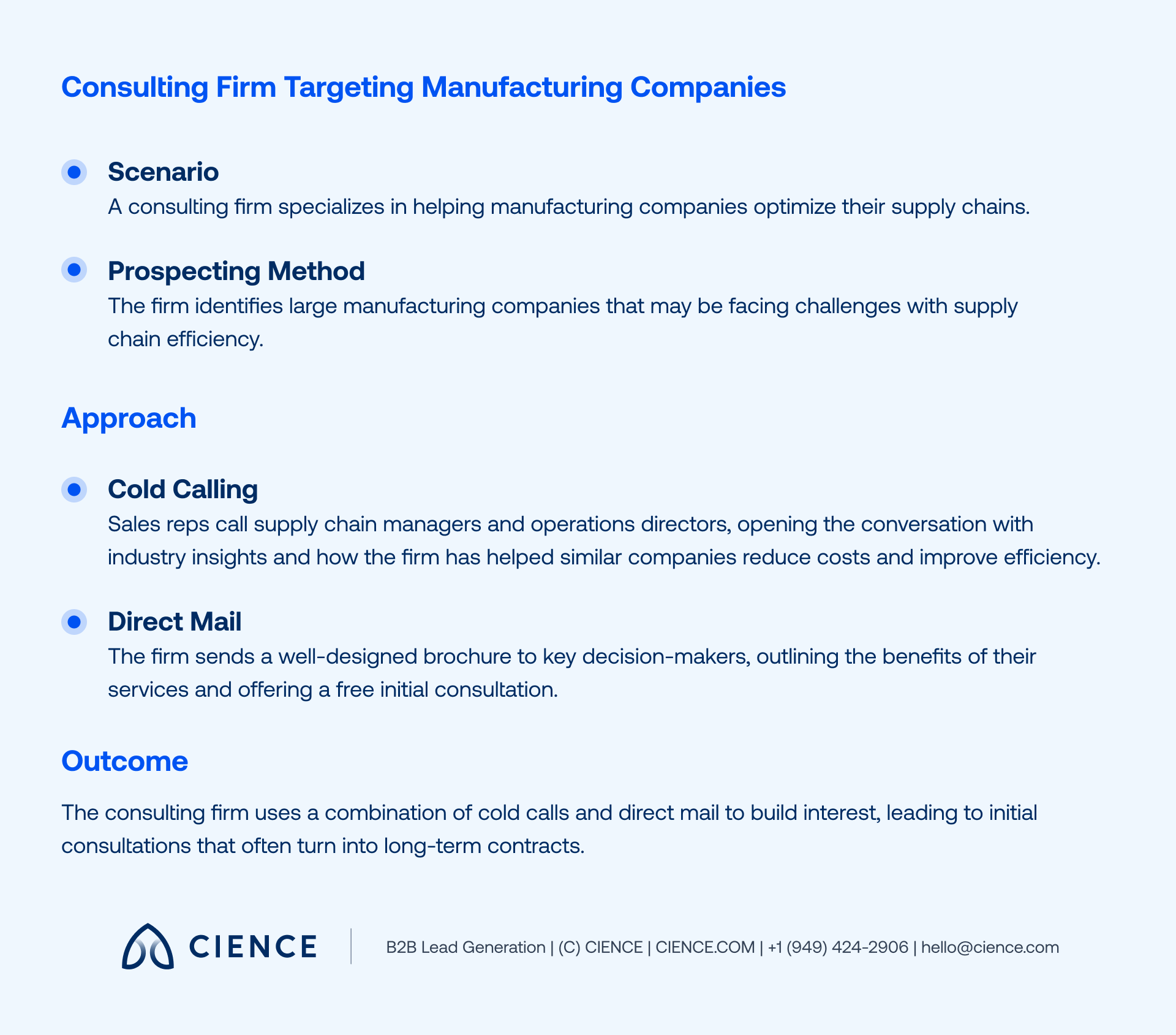
Cold calling is more alive than ever as one of the best prospecting methods. It can be defined as a prospecting technique used to start business conversations with decision-makers over the phone. The goal is to raise awareness and ultimately set up a discovery appointment with the appropriate individual.
Sales Prospecting Example:
Cold email campaigns
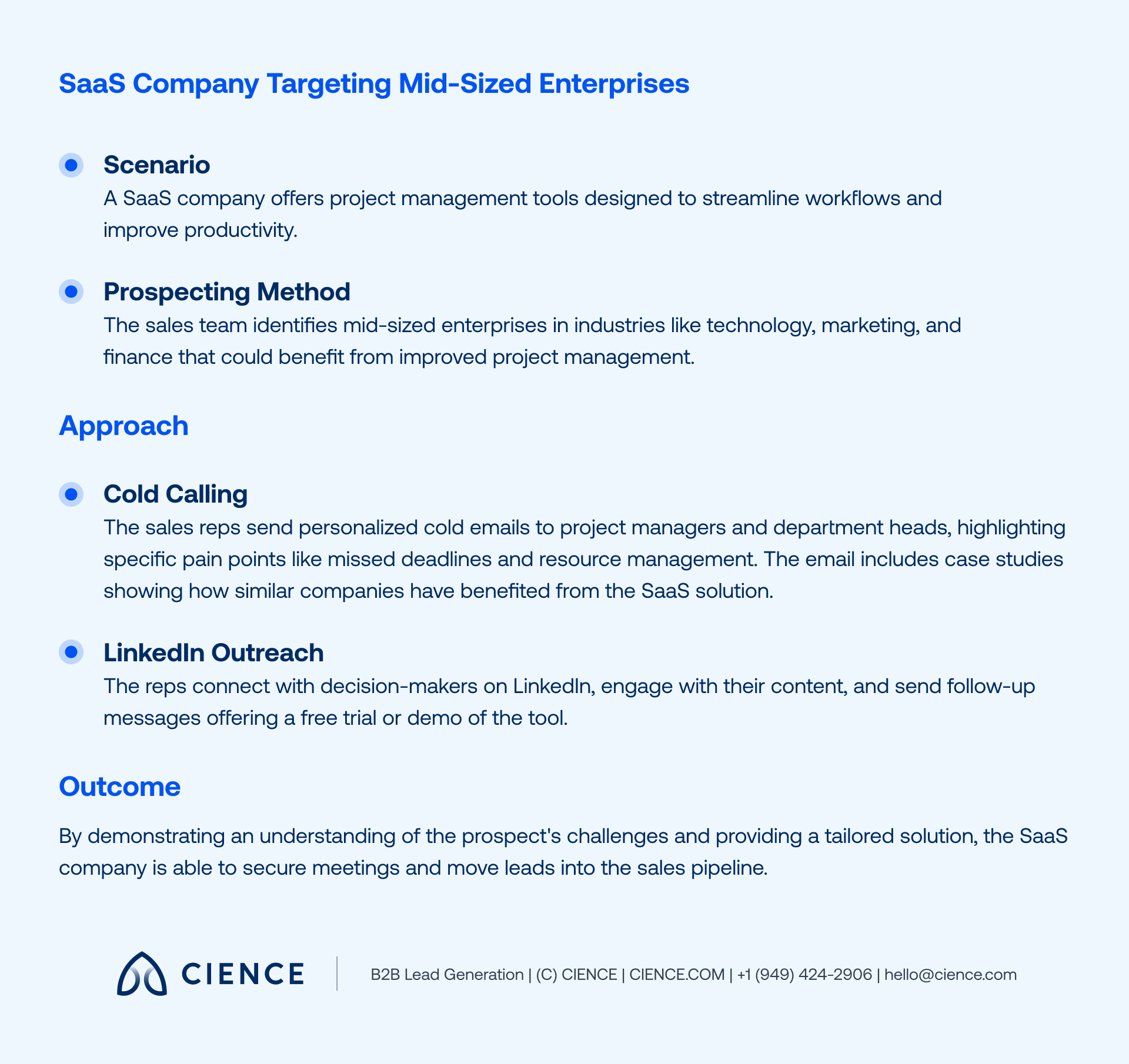
A cold email is an initial email sent to a recipient without prior contact to start business conversations. It’s similar to cold calling but much less intrusive. Email campaign strategies allow B2B companies to create tailor-made messages so prospects feel like you understand their pain points and know how to solve them.
Remember you can always use cold email templates to help you get started. Coupling these templates with creative personalization can make your cold email campaigns an even more powerful tool in your prospecting arsenal.
Sales Prospecting Example:
Remarketing campaigns
Remarketing is a prospecting method in which a marketer re-engages with someone who has shown interest in their company but has not yet taken the desired action. This could take many forms, like clicking a programmatic ad, visiting your website, opening a customized email, or even following your page on social media.
LinkedIn campaigns
LinkedIn is an invaluable tool for prospecting. It is a great place to find potential leads and build relationships with them. It allows you to research companies, find decision-makers, and reach out to them directly. You can also join groups related to your industry and connect with people who share your interests.
📑 Related article: How to Prospect on LinkedIn
Website visitor tracking campaigns
Website visitor tracking is a useful tool for prospecting as it allows businesses to gain insights into their customer behavior. Additionally, website tracking can provide valuable insights into customer segmentation, allowing businesses to develop more effective strategies for reaching different customer groups.
Content Marketing
Producing valuable content such as blogs, white papers, and case studies can attract potential customers. Content marketing supports inbound prospecting by providing prospects with information that draws them into your sales funnel. Additionally, repurposing content in outbound campaigns, such as sharing a relevant blog post in a cold email, can boost engagement.
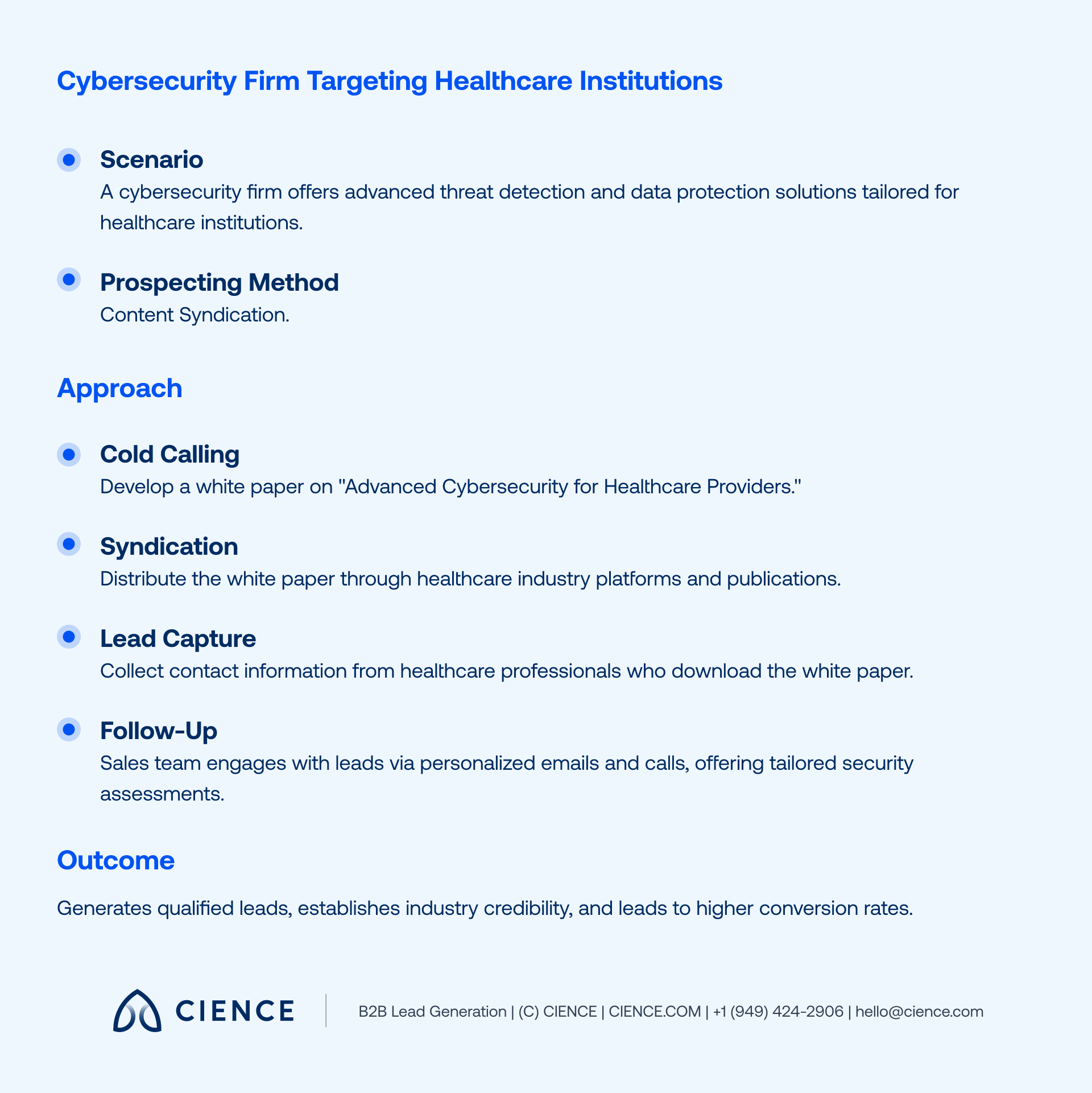
Sales Prospecting Example:
Direct Mail
While it may seem old-fashioned, direct mail automation can still be a highly effective prospecting tool, especially when targeting specific high-value prospects. A well-crafted piece of direct mail, such as a personalized letter or a unique package, can stand out in a digital world and grab the attention of potential clients.
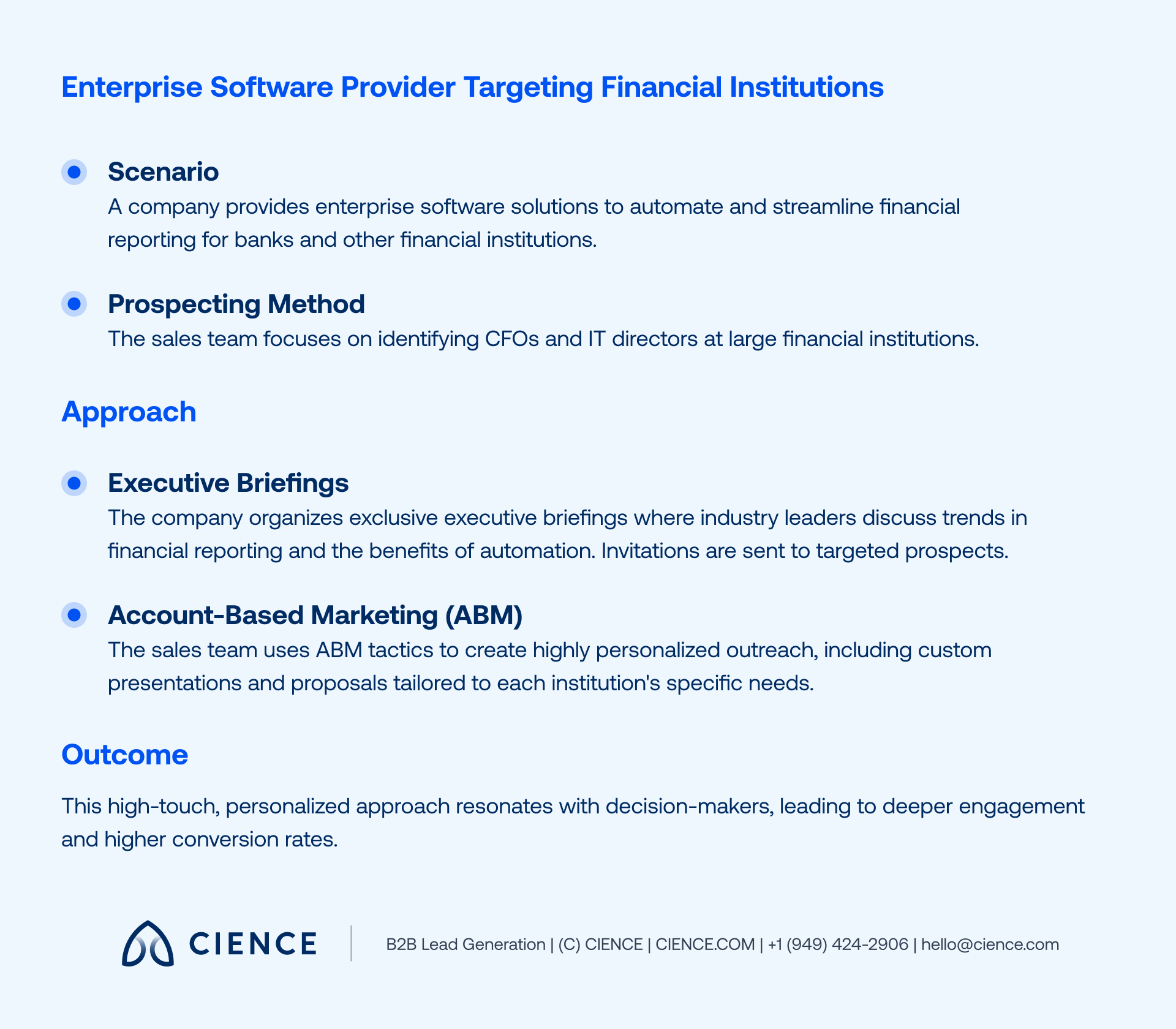
Account-Based Marketing (ABM)
ABM is a targeted approach where sales and marketing teams work together to focus on high-value accounts. This method involves personalized campaigns designed for individual companies or decision-makers, often including tailored content, outreach, and programmatic advertising specific to the prospect’s needs.
Sales Prospecting Example:
Social Selling
Beyond LinkedIn, social selling involves using various social media platforms to connect with prospects and build relationships. Sales reps can engage with prospects by commenting on their posts, sharing relevant content, and participating in industry-related discussions to stay top-of-mind.
Referral Programs
Leveraging existing customers to gain new leads through referral programs can be a powerful prospecting method. By offering incentives for referrals, companies can tap into the networks of satisfied customers to reach new prospects who are likely to be interested in their products or services.
Networking Events and Conferences
Attending industry events, conferences, and trade shows is a traditional yet highly effective method of prospecting. These events offer opportunities to meet potential clients face-to-face, build relationships, and establish credibility. Sales reps can collect business cards and follow up with personalized messages after the event.
Webinars and Online Workshops
Hosting webinars or online workshops on topics relevant to your industry can attract prospects interested in your expertise. These events provide an opportunity to showcase your knowledge, engage with attendees, and collect contact information for follow-up.
How to Prospect: 7-Step Sales Prospecting Process
The sales prospecting process is a systematic approach that sales teams use to identify, qualify, and engage potential customers. It is a crucial part of the sales cycle, as it lays the foundation for building a robust pipeline of leads that can be converted into customers. Here’s a breakdown of the key steps involved in the sales prospecting process:
1. Define Your Ideal Customer Profile (ICP)
- Objective: Before you start prospecting, it’s essential to clearly define who your ideal customers are. This involves identifying the characteristics of companies or individuals who are most likely to benefit from your product or service.
- Activities: Analyze your current customer base, research market trends, and create detailed profiles based on factors like industry, company size, job roles, pain points, and buying behaviors.
2. Build a Prospect List
- Objective: Create a list of potential customers who match your Ideal Customer Profile.
- Activities: Use various tools and methods such as CRM systems, LinkedIn, industry directories, and B2B data providers to gather a list of companies and decision-makers. Segment this list based on factors like industry, company size, or geographical location to tailor your outreach.
3. Research and Qualify Prospects
- Objective: Not all prospects are created equal. The next step is to research and qualify your prospects to determine if they have the potential to become customers.
- Activities: Conduct research on each prospect to understand their specific needs, challenges, and whether they have the authority and budget to make a purchasing decision. This can involve looking at their company’s website, recent news, social media activity, and industry reports.
4. Initiate Contact
- Objective: Start the conversation with your prospects using personalized outreach methods.
- Activities: Depending on your strategy, you might begin with cold emails, phone calls, LinkedIn messages, or direct mail. The key is to personalize your communication to address the specific needs and pain points of the prospect, making it clear how your product or service can help them.
5. Engage and Nurture
- Objective: Build a relationship with the prospect by engaging them in meaningful conversations and providing valuable information.
- Activities: Follow up regularly with your prospects, share relevant content like case studies, white papers, or webinars, and invite them to events or demos. The goal is to nurture the relationship until they are ready to move forward in the buying process.
6. Qualify the Prospect
- Objective: Assess whether the prospect is a good fit for your product or service and if they are ready to move to the next stage of the sales process.
- Activities: Engage in deeper conversations to understand their specific needs, timeline, and budget. Use qualification frameworks like BANT (Budget, Authority, Need, Timing) to determine if the prospect is worth pursuing.
7. Hand Over to Sales
- Objective: Once a prospect is fully qualified, they are handed over to the sales team for closing.
- Activities: Provide the sales team with detailed notes on the prospect’s needs, challenges, and decision-making process. The sales team will then take over, aiming to convert the prospect into a customer through presentations, negotiations, and contract discussions.
📑 Related article: How to Build a Strategic Sales Prospecting Plan
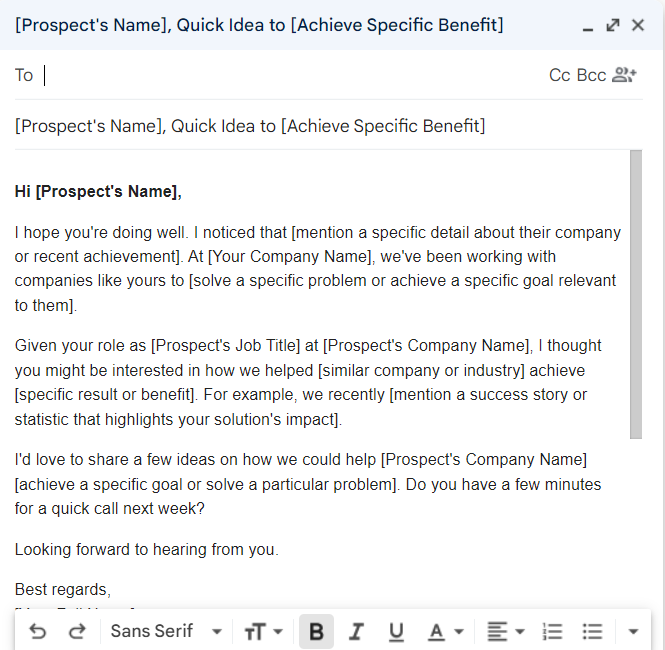
Sales Prospecting Email Template
Creating a compelling sales prospecting email is crucial for engaging potential customers and setting the stage for a productive conversation. Below is an effective email template that balances personalization, value, and a clear call to action.
📑 Get More Templates for B2B Prospecting
Top 5 Prospecting Tips
Prospecting clients is about building trust-based relationships, which sounds like something that’s hard to pin down. However, it’s possible to have a sound prospecting strategy in place to help you build those relationships, and if you pursue them diligently, the return for your efforts will be greater.
Here are five essential prospecting tips that will help your marketing and sales teams to engage your potential customers more effectively:
1. Thoroughly understand the customer you hope to find.
If you don’t know precisely who you’re looking for, there is a chance you might find the right prospect anywhere. But at the same time, you’ll waste most of the time pursuing people who are uninterested in the products and services you offer. That’s why it’s essentially important to outline your prospecting strategy.
You’ll need to understand the demographics and other special characteristics that fit your ideal customer to identify their needs. At the start, you can focus your efforts more on using referrals and researching your existing clients.
Then, search for prospects with similar needs to them. Developing an ideal customer persona and appealing to the problems they want to solve when getting to you shows consideration and empathy, rather than just trying to win a sale.
📑 Related article: Top Sales Prospecting Tools
2. Know where to find your potential client.
Sales leads may be found in places other than where you expect. Years ago, Land Rover created a ruggedized mobile phone that they expected to sell to outdoor laborers like construction workers. It didn’t take long for them to realize they had another market they didn’t expect: mothers of toddlers in the suburban jungle.
While you want to make the most of the knowledge you get from your customer base, it’s worth expanding your concept and figuring out who might be well-served by your products as well. Then, do a little research, and find out where they tend to congregate online, their areas of interest, and what needs they have.
If you don’t have the bandwidth or a team dedicated to prospect research, companies like CIENCE are able to supply qualified leads and research directly to you every week.
3. Define and articulate your unique value proposition.
Your unique value proposition (UVP) is a concise statement of the benefits your product or service delivers to your ideal customer. This includes a description of the product or service, the definition of the target audience, and the value of your product or service.
In other words, with a UVP, you explain what is so special about your offer that your prospects can’t do without. This can be something as simple as getting more time, increasing the cost-efficiency of the product, or improving customer retention. Your UVP should clearly define what the ideal customer will gain and experience after they buy from you.
To do good customer prospecting for business, you should clearly understand your unique value proposition and be ready to articulate it to others.
4. Devote time to prospecting with a disciplined strategy.
No doubt, there is an art to prospecting. But success largely depends on making the commitment and sticking with it. Developing a disciplined prospecting strategy helps to ensure you maximize the returns of your effort and that you don’t forget any important steps that might let customers slip through the cracks.
To start with, you can designate thirty minutes each morning to client prospecting, set a goal of a certain number of prospecting calls per week, and determine how much of each week should be devoted to new business development. Tracking your results and refining your approach should also be part of the prospecting strategy. While measuring spending time prospecting is important, this shouldn’t harm other sales processes which need your undivided attention.
5. Use sales prospecting tools and services to give you the advantage.
Without the right tools or system in place, it’s easy to get lost in the sea of prospecting. How do you know which leads are active or even ready to buy? Which ones do you target and which ones do you leave for now? Data service providers like CIENCE have the tools that make prospecting easier to navigate.
Client prospecting starts with a careful evaluation of your ICP. Your parameters get entered into the database and are matched with actual contacts. These records are ready for prospecting and available to you throughout the whole course of your engagement.
💡 Explore the best B2B prospecting tools.
Meanwhile, if you want to go deeper, there are highly professional researchers who can conduct data analysis to segment your customers into specific categories. It’s later followed by creating personalized advertising and outreach campaigns to deliver unique customer experiences across multiple channels.
Incorporate AI in your sales prospecting strategy. AI can significantly enhance your prospecting efforts by automating and optimizing various tasks, allowing your team to focus on building relationships. AI tools can analyze vast amounts of data to identify high-potential leads that match your ideal customer profile.
By integrating AI into your prospecting process, you can improve efficiency, enhance personalization, and ultimately increase conversion rates.
Outsourcing a prospecting team is more cost-effective than hiring one in-house. Instead of spending time on routine tasks, you can focus on building meaningful relationships with your clients.
“Thanks to CIENCE, we’ve seen a 500% monthly increase in new sales appointments.” — Bryce Garoutte, Sr. VP of Business Dev & Marketing, Silicon Valley Insight
“CIENCE created a scalable, predictable pipeline from day one — we generated over 4,000 leads in just four months.” — August Ash
CIENCE + graph8 pricing: $5,000 one-time GTM system setup, $2,499/mo strategic execution, and the graph8 platform at $499/mo. No long-term contracts. See full pricing →
Whether or not you decide to work with us, you’ll walk away with a clear picture of where your pipeline is leaking and what it would take to fix it.
Frequently Asked Questions
What is the difference between prospecting and lead generation?
Prospecting is a subset of lead generation focused on outbound activities — actively identifying and reaching out to potential customers. Lead generation is broader, encompassing both inbound (content, SEO, ads) and outbound methods. Prospecting is typically done by SDRs, while lead generation involves both sales and marketing teams.
How many hours per day should sales reps spend prospecting?
Most sales experts recommend dedicating 1-2 hours per day to focused prospecting activities. Consistency matters more than volume — 60 minutes of targeted outreach to well-researched prospects outperforms 4 hours of mass cold calling. Block prospecting time on your calendar and protect it from meetings.
What are the best prospecting tools?
The most effective B2B prospecting tools include CIENCE GO Data for verified contact lists, LinkedIn Sales Navigator for social selling, and tools like Apollo, ZoomInfo, and Outreach for multi-channel sequences. CRM integration is essential — use Salesforce or HubSpot to track all prospecting activity.
Is cold calling still effective for prospecting?
Yes. Despite the rise of email and social selling, cold calling remains one of the highest-converting prospecting methods when done properly. The key is research — spend 5-15 minutes researching each prospect before calling, use a tested script, and follow up within 24-72 hours. Combining cold calling with cold email increases response rates significantly.
Get Ready to Prospect
Customer prospecting isn’t easy, but with the right techniques, software, and dedicated time it can become a more seamless process. Be sure to measure the amount of time your team dedicates to prospecting daily.
If it takes up more time than you’d like, working with a lead generation company is worth the investment. It enables you and your team to focus on the sale and increases the likelihood of closing even more deals.
CIENCE’s meticulous outbound solutions take care of prospecting your clients. With the help of cutting-edge technology and human intelligence, you get personalized campaigns targeted to your ideal customer profile, customized email and phone outreach, and reliable appointment setting. Start Prospecting with CIENCE →

A graph8 company — AI-powered GTM execution across 250+ B2B industries.
graph8 Platform
From $499/mo
Run your own GTM campaigns with AI-powered data, sequences, and analytics.
Start Free — 2,500 Credits No credit card requiredCIENCE Managed
From $2,499/mo
Our GTM teams build and run your outbound campaigns end-to-end.
15-min call · No commitment2,500+ B2B companies served · Month-to-month contracts · See full pricing →