
A data-driven sales strategy uses collected sales interaction data to improve team performance, targeting, and conversion rates. BARC research shows data-driven sales increases profits by 8% and reduces costs by 10%. The 5-step framework includes aligning teams, assigning data ownership, gradual implementation, reviewing existing CRM data, and continuous KPI tracking using metrics like conversion rates and customer acquisition costs.
Last Refreshed: March 2026 with updated statistics and tool information.
A data-driven sales strategy is a method of collecting and analyzing all sales interaction data to enhance team performance, improve targeting, and increase conversion rates across the entire sales cycle.
From Daniel Conn, GTM Strategist, graph8: “A data-driven sales strategy only works if the underlying data is trustworthy. Most teams are making targeting decisions on CRM records that are 12–18 months stale — then wondering why conversion rates disappoint. Clean, enriched intelligence is the actual lever.”
“Without big data analytics, companies are blind and deaf, wandering out onto the web like deer on a freeway,” said Geoffrey Moore, author of Crossing the Chasm and business advisor. The number of organizations relying on data and analytics has only accelerated since, with 95% of C-level executives stating that data is an integral part of their business strategy formation.
With the permanent shift to digital-first remote sales teams, the sales process has fundamentally changed. A McKinsey report states that about 80% of B2B decision-makers prefer digital and remote engagement over in-person interactions. Companies that want to win in this environment need a data-driven formula for converting prospects online.
What Is a Data-Driven Sales Strategy?
A data-driven sales strategy is a method of data collection of all sales interactions with potential and existing customers in order to enhance the sales team’s performance. In other words, the data-driven sales approach implies gathering all the stored information on your product and sales activities and transforming it into unlooked-for insights to improve the sales process of the company in general.
In fact, the sales department is the second most data-driven in their decision-making (42%) after finances (62%). The emails you’ve sent, the time of the phone calls you made, the pieces of content you linked to, and the targeted ads you placed—all of these can become enlightening sales data to help you build better communication with your prospects.
By analyzing which templates received the most answers, what time of the day your sales reps close most deals, what the average deal size is, what part of the sales funnel needs improvement, etc., you can accelerate your team’s effort and build a more efficient sales cycle.
Explore CIENCE B2B data solutions.
Main Benefits of a Data-Driven Sales Strategy
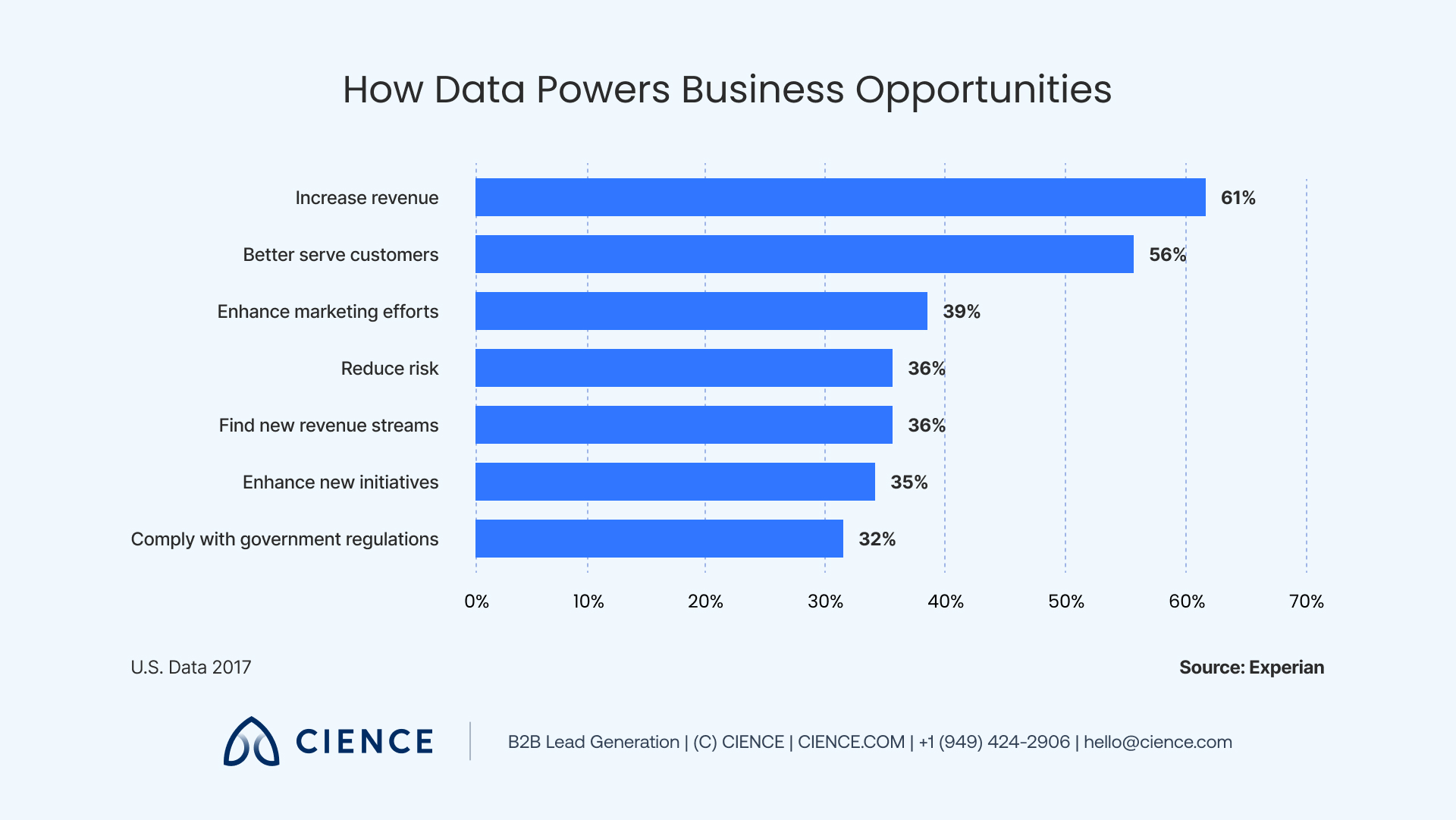
There are multiple reasons to start using data for sales in your organization. The Global Data Management Benchmark Report by Experian identifies the top ones:
There are also other compelling reasons why data-driven sales is essential for every B2B organization today:
1. Better targeting
The more data points on your prospects you can collect, the more precise your targeting strategy can become. In fact, more than half of sales professionals (56%) are already using data to more accurately target the prospects they are most interested in. By knowing the exact location, industry, and business size of your ideal customer profile (ICP), you can forget about the spray and pray approach and thousands of dollars spent on ads in vain.
2. More efficient outreach
Data-driven sales help to better understand your prospect: the challenges they are most likely to face, pain points they have, and their business goals. By finding answers to these and many other questions, your team can build a more personalized outreach strategy without investing hours on researching for information manually.
3. Higher productivity of the sales team
By automating certain aspects of the sales representative’s workflow with the help of big data, you can expect a boost of your team’s productivity too. McKinsey’s Marketing and Sales report proves this point: “Companies that inject big data and analytics into their operation show productivity rates and profitability that are five percent to six percent higher than those of their peers. That’s an advantage no company can afford to ignore.”
4. Increased profitability
Sales data is extremely beneficial for the company’s revenue too. According to the BARC research, data-driven sales solutions allow increasing the company’s profits by 8% while also reducing the total cost of operations by 10%. This is quite impressive — in a market where every operational dollar is scrutinized, data-driven decisions are no longer optional. See also: how to survive a recession in business.
How to Build a Data-Driven Sales Approach

Every organization has to work on creating its own data-driven sales depending on the company’s resources and future goals. If you are looking into transforming your usual sales routine workflow into a data-collection process to provide better services and maximize your profit, here are five main steps you can follow to ensure a successful shift.
Step 1: Get everyone on board and coordinate your actions.
Establishing a data-driven sales mindset isn’t an easy goal to achieve. Thirty-nine percent of professionals indicate that lack of internal communications between teams is one of the major obstacles to data culture implementation.
Therefore, the very first step to data-driven sales is making sure that all departments are on board with it and fully understand the benefits of this approach. Convincing sales, marketing, IT, finances, and other teams to communicate better and switch to a new strategy simultaneously may sound easy on paper, but it is way more challenging in real life.
Explore data-driven strategies for marketing.
Very often, certain team members (and especially the management) are not fully ready to accept the change. For them, it is always easier to keep the processes the way they were before than to learn something new from scratch. However, even if a certain strategy worked well for your team a few years ago, it will not necessarily be effective today. The change to sales data is inevitable, and the earlier your team accepts it, the better it will be for your business.
Once you’ve managed to convince your team members about the value of data-driven sales, the next step will be to coordinate your actions:
- Define the main goals you want to achieve with the help of sales data.
- Operationalize these qualitative goals into quantitative metrics that you can measure and track over time to see progress.
- Decide on the type of datasets needed to achieve these goals.
- Choose a strategy to collect the needed data.
It is essential to have the entire company working together, combining their efforts, skills, and resources to secure a successful transition into a data-driven sales strategy.
Step 2: Decide who and how to collect the data.
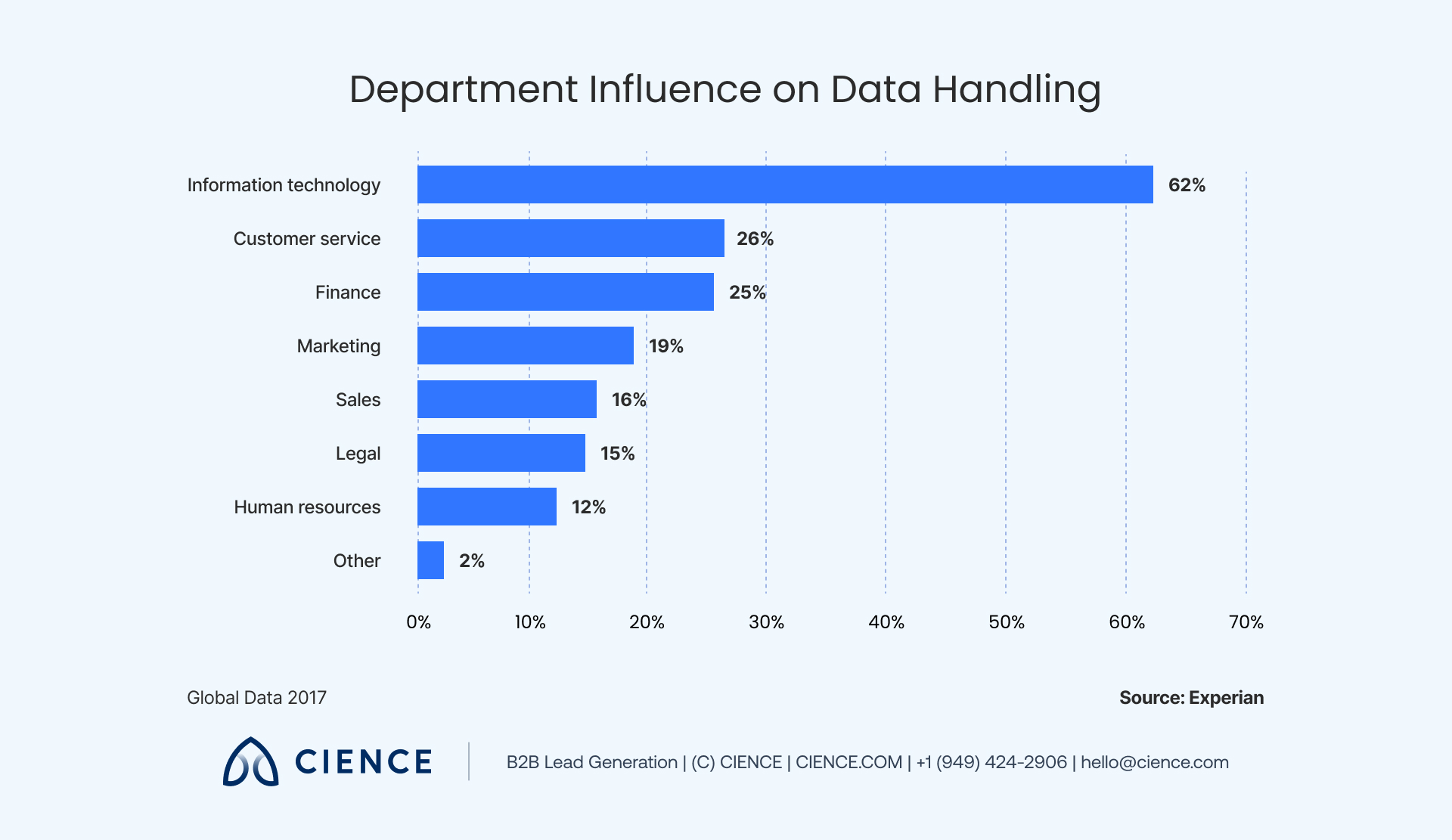
To avoid any possible mistakes during data collection due to miscommunication between different departments, you need to assign this task to someone in particular. In most organizations, the IT department is in charge of data gathering, recording, presenting, and storing.
However, you are free to choose any department to handle this job if they have the needed resources to perform these tasks. It’s also acceptable to create a new position inside a certain team specifically for sales data processing. The main thing at this stage is to ensure that whoever is in charge of this important task has all the essential tools and knowledge to complete it.
When assigning data handling to an in-house team, you have to also remember about the data quality. The impact of low-quality sales data is dramatic. You are risking wasting your team’s time without getting anything in return, losing large sums of money on inefficient decisions, and even harming your company’s reputation by reaching out to the wrong people.
As the biggest contributor to data inaccuracy is a human error (49%), make sure to automate most processes with the help of sales automation tools and minimize the chances of a mistake.
Explore the best sales email automation tools.
Step 3: Make the shift to data-driven solutions smooth and gradual.
Applying even the smallest modification in the company’s workflow takes a lot of time. Changing the entire approach to sales requires even more time. Building a data-driven sales approach means not just coming up with the perfect strategy on paper but successfully implementing it in real life. This might include restructuring the entire sales department, educating your team from scratch about new technologies, tracking their progress, and searching for a weak spot in your sales cycle to work on.
Don’t expect to have the completed strategy being ready to go in a couple of weeks. Data-driven sales is about constant improvement and the search for new solutions. The more time you allow yourself and your team to adopt the data-driven sales set of mind, the more thriving the results will be. Don’t rush this process but better encourage your team to use data for sales step-by-step.
Step 4: Review the data collected by your team already and scale it.
You might not even realize this, but if your team uses customer relationship management (CRM) tools, you’ve already started the process of data collection. The voice messages you’ve left, the follow-ups you’ve sent, the meetings you’ve conducted, and the leads you’ve converted—all of this can be easily combined into a large dataset to help you get established with a data-driven sales strategy.
The better you tracked all your sales interactions before, the easier it will be to extract high-quality data from it. In fact, the top 3% of best-performing salespeople are more confident in their CRM data than their less successful colleagues. The pattern is obvious — the higher conversions you want to get, the better your data has to be recorded.
Explore the top sales intelligence tools.
Unless your data is completely outdated, or you’ve developed an entirely new product for a niche market you want to conquer, you can always convert the data you already have access to into important insight about your sales routine and target audience. Define the data points your dataset lacks and complement them with the necessary information.
Step 5: Keep collecting data and track your progress.

The sales data collection process never ends. Once you start it, you have to keep doing it, searching for more incisive and thoughtful facts to improve your team’s operations each time. Thus, you can define what time and day of the week work best to send sales emails, how many interactions it takes to set up a discovery call, what industries purchase which products, and what sales activities drive the most results.
To ensure that your data-driven strategy drives results, you need to measure your progress with a help of a few main KPIs like conversion rates, customer acquisition costs, customer lifetime value, return on investment, etc. You are free to add any other metrics that are essential for your business to ensure that all sales operations are gradually developing.
From Quincy Berg, SDR Operations Lead, CIENCE: “The teams that improve fastest aren’t the ones with the most data — they’re the ones who review their KPIs weekly and adjust. A monthly cadence is too slow. By the time you spot a problem, you’ve already lost a month of pipeline.”
Bad data doesn’t just waste budget — it trains your team to accept poor results as normal. Clean intelligence changes everything.
Read about 9 best KPIs to track in B2B sales.
“Thanks to CIENCE, we’ve seen a 500% monthly increase in new sales appointments.” — Bryce Garoutte, Sr. VP of Business Dev & Marketing, Silicon Valley Insight
CIENCE + graph8 pricing: $5,000 one-time GTM system setup, $2,499/mo strategic execution, and the graph8 platform at $499/mo. No long-term contracts. See full pricing →
Whether or not you decide to work with us, you’ll walk away with a clear picture of where your pipeline is leaking and what it would take to fix it.
“CIENCE’s approach is data-driven and measurable — they bring a scientific rigor to lead generation that most agencies simply don’t have.” — Reputation X
Frequently Asked Questions
What tools do you need for a data-driven sales strategy?
The essential tools include a CRM platform like Salesforce or HubSpot for tracking interactions, a business intelligence tool like Tableau or Power BI for visualization, and a data enrichment platform like CIENCE or ZoomInfo for prospect intelligence. Most companies also benefit from sales engagement platforms that automate outreach while capturing performance data.
How do you measure the success of a data-driven sales strategy?
Track 5 core KPIs: conversion rate, customer acquisition cost (CAC), customer lifetime value (CLV), average deal size, and sales cycle length. BARC research shows that data-driven companies increase profits by 8% while cutting costs by 10%. Compare these metrics quarter-over-quarter to gauge improvement and identify which data inputs drive the best outcomes.
What is the biggest challenge in implementing a data-driven sales approach?
The biggest obstacle is internal resistance to change, with 39% of professionals citing poor cross-team communication as the primary barrier. Successful implementation requires executive buy-in, gradual rollout, and training programs that show individual team members how data improves their personal performance and commission outcomes.
Embrace the Power of Data for Sales
Data can become a very powerful tool in the hands of a talented sales manager. If you know how to read it correctly and how to extract valuable information out of it, you can open the door to completely new business opportunities in the digital sphere. With a well-implemented data-driven sales strategy, you can become a better company for both your clients and employees. Offer more personalized solutions, optimize your sales team workflow, drive higher conversions — and move with the data-oriented present. CIENCE has helped 2,500+ clients across 250+ industries do exactly that.

A graph8 company — AI-powered GTM execution across 250+ B2B industries.
graph8 Platform
From $499/mo
Run your own GTM campaigns with AI-powered data, sequences, and analytics.
Start Free — 2,500 Credits No credit card requiredCIENCE Managed
From $2,499/mo
Our GTM teams build and run your outbound campaigns end-to-end.
15-min call · No commitment2,500+ B2B companies served · Month-to-month contracts · See full pricing →