A go-to-market (GTM) strategy is a step-by-step plan for launching a product or entering a new market — and 45% of new businesses fail within 5 years without one. This 10-step framework covers ICP development, buyer journey mapping, channel selection, and intent signals — with real GTM examples from Deel, Notion, Typeform, and Slack showing how it translates to explosive pipeline growth.
Last Refreshed: March 2026 with updated statistics and tool information.
A go-to-market (GTM) strategy is a step-by-step plan that outlines the actions needed to successfully launch a product or expand into a new market, covering everything from ICP definition and competitive analysis to channel selection and demand generation.
From Thomas Cornelius, Founder & CEO, graph8: “Most GTM failures aren’t execution failures — they’re architecture failures. Companies launch with a great product but no system connecting data, outreach, and conversion. The teams that win treat GTM as an engineering problem, not a calendar exercise.”
Launching a new B2B product is never easy. According to the U.S. Bureau of Labor Statistics (BLS), approximately 20% of new businesses fail during the first two years of being open, 45% during the first five years, and 65% during the first ten years. The go-to-market approach aims to lower these numbers to the bare minimum.
The reasons behind why so many businesses fail are diverse. They go from not being able to identify a proper need that demands a solution, not understanding the depths of the market, failing to set the right pricing, to underestimating the competition.
Without the proper planning, B2B marketing and sales teams are more prone to miss the mark and waste valuable time, energy, and budget, which may end up being fatal for projects with limited resources. Thankfully, a go-to-market strategy can be employed to map each action.
Commonly labeled as an “early marketing plan,” a go-to-market strategy provides a practical guide for sales and marketing teams that want to stay on track from day one — covering the processes, tools, and examples that turn a product launch into a repeatable pipeline.
What Is a Go-to-Market Strategy?
A go-to-market (GTM) strategy is a step-by-step plan that defines the actions needed to successfully launch a product or expand into a new market.
Similar to a B2B marketing strategy, which combines inbound and outbound efforts to reach its target market, GTM strategies focus on the earliest stages of brand positioning to educate potential customers about the unique value proposition (UVP) derived from the offered product.
Implementing a go-to-market strategy is crucial for understanding how the B2B pipeline growth process will behave once the product is on sale. Important B2B lead generation questions can be answered through well-structured GTM strategies. Here are some examples:
- What particular need does your product solve?
- Who is your ideal client, and what are their pain points?
- What markets do you wish to target, and how do those markets fare in terms of demand and competition?
- How will you generate demand and reach your target audience?
Learn More About GTM Strategies
Go-to-Market Approaches
The costs involved in B2B product launching are usually high. For that reason, sales and marketing teams want to make sure they are aiming at the most profitable prospects from the very start. Go-to-market strategies can do just that.
A key step involved in the go-to-market process is defining your total addressable market (TAM), which can translate to the sum of all the available prospects in every country, industry, and hierarchy with enough budget to purchase your product.
Once the TAM is ready to go, sales and marketing reps need to work together to define their ideal customer profiles (ICPs). These detailed files describe a company that would be a perfect match for your product. Specific criteria like revenue, size, background, geography, industry, and technology usage are considered for their crafting.
There are two main go-to-market methodologies that can help B2B companies to access their ICPs:
Funnel GTM strategy
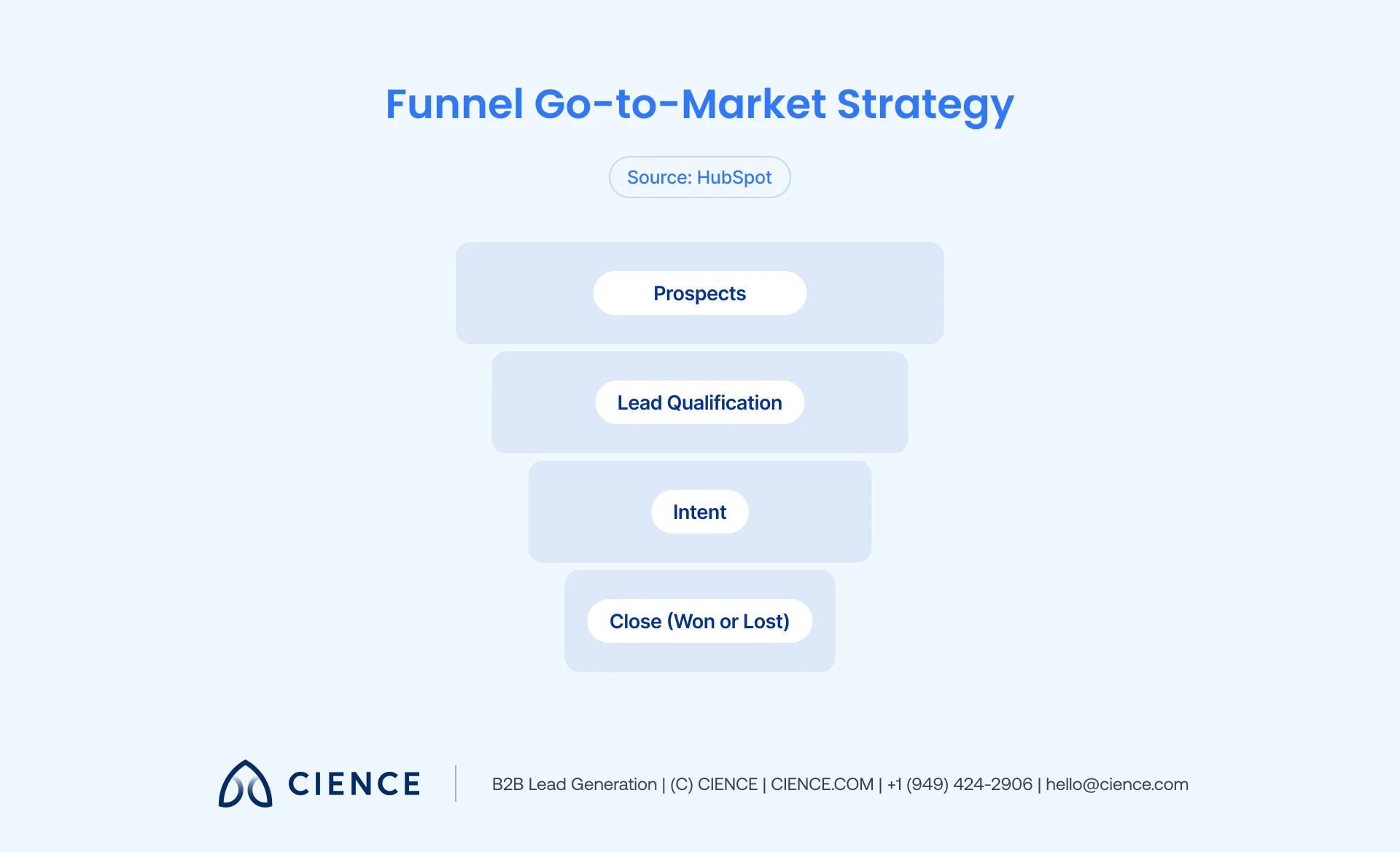
The traditional sales funnel method mimics the different stages a lead must go through to become a client. Each stage possesses its own set of touchpoints; some are content-based while others are sales-driven, and the sum of them filter leads until only the best-fitting prospects remain.
There are four main steps every sales funnel must include to drive successful results:
1. Awareness. B2B decision-makers become aware of a problem that demands a solution, find out about your brand, and want to learn more about how your product could solve their need.
2. Qualification. Leads enter your outbound or inbound pipeline. Distinct processes to verify how many of these leads may be a good match for your company are set in motion. The closer they are to your ICPs, the higher chances of conversion.
3. Intent. Prospects now show a clear interest in your product. They request vital information that will help them compare your solution with other similar offers.
4. Action. Prospects consider all the data assets at their disposal and make a decision. If the deal is lost, it can be entered into a passive follow-up campaign. If the deal is won, an upsell campaign is triggered.
Flywheel GTM strategy
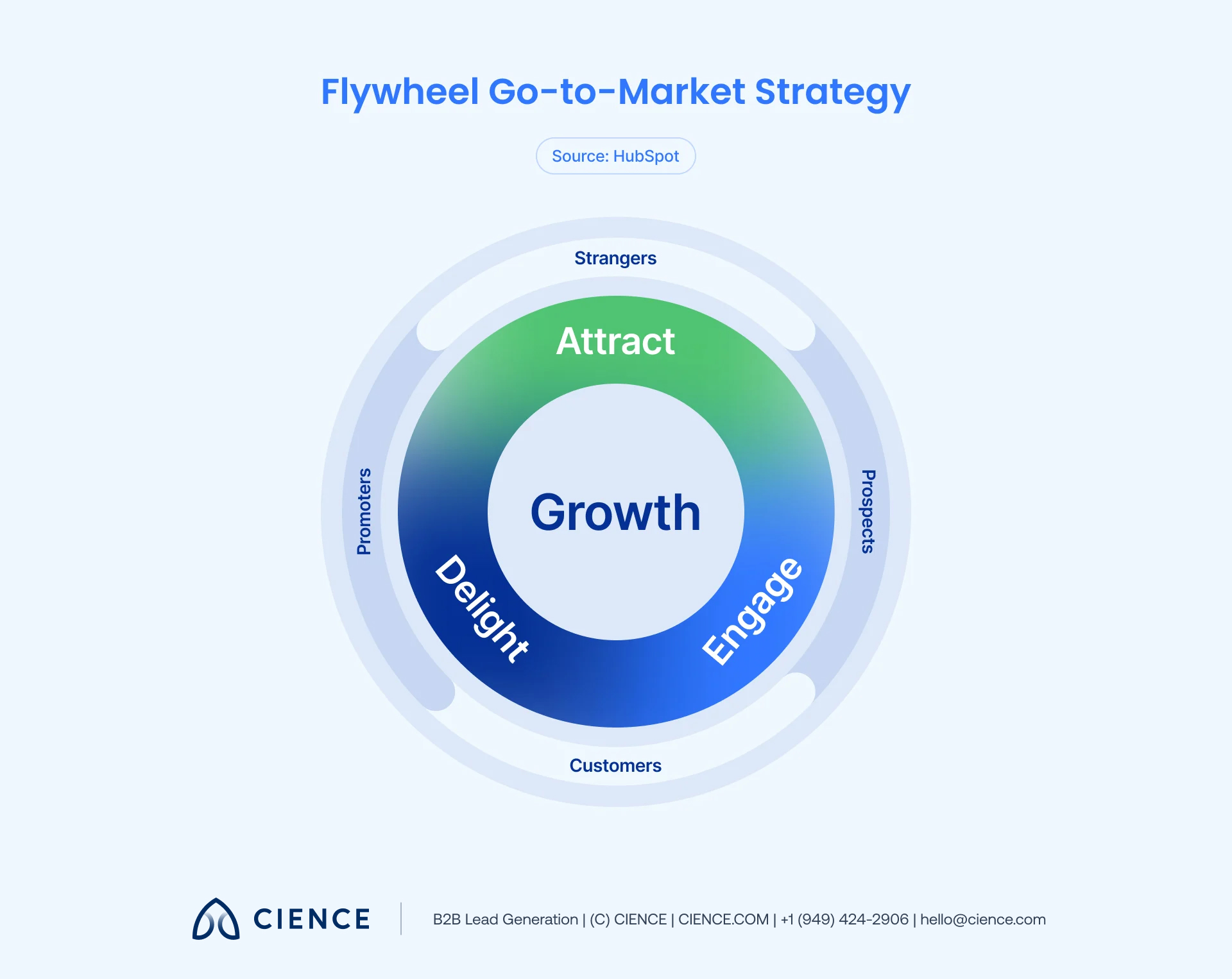
The flywheel model takes the lead into a more holistic path. Each touchpoint is specifically designed to turn strangers into prospects, prospects into customers, and customers into promoters so new strangers can be attracted to the cycle.
This is how the flywheel process works:
1. Attract phase. Visitors are lured into your website through useful content to educate themselves about your brand. Thanks to intent data tactics, it is possible to identify the in-market users that are already searching for solutions that are similar to the ones you offer.
2. Engagement phase. Multichannel openness allows leads to engage with your company whenever they feel ready to start productive sales conversations. This phase focuses on providing the prospect with everything they need to make their decision.
3. Delight phase. Prospects are now clients. This is the time to show the full display of your product, crew, and problem-solving power. Customers will be happy to share their testimonials after their goals are reached.
As sales and marketing teams analyze the results of the applied GTM methodologies, they can alternate, edit, and even combine tactics from both approaches to access the most valuable leads.
Leverage Go-to-Market Strategies
Go-to-Market Strategy Framework
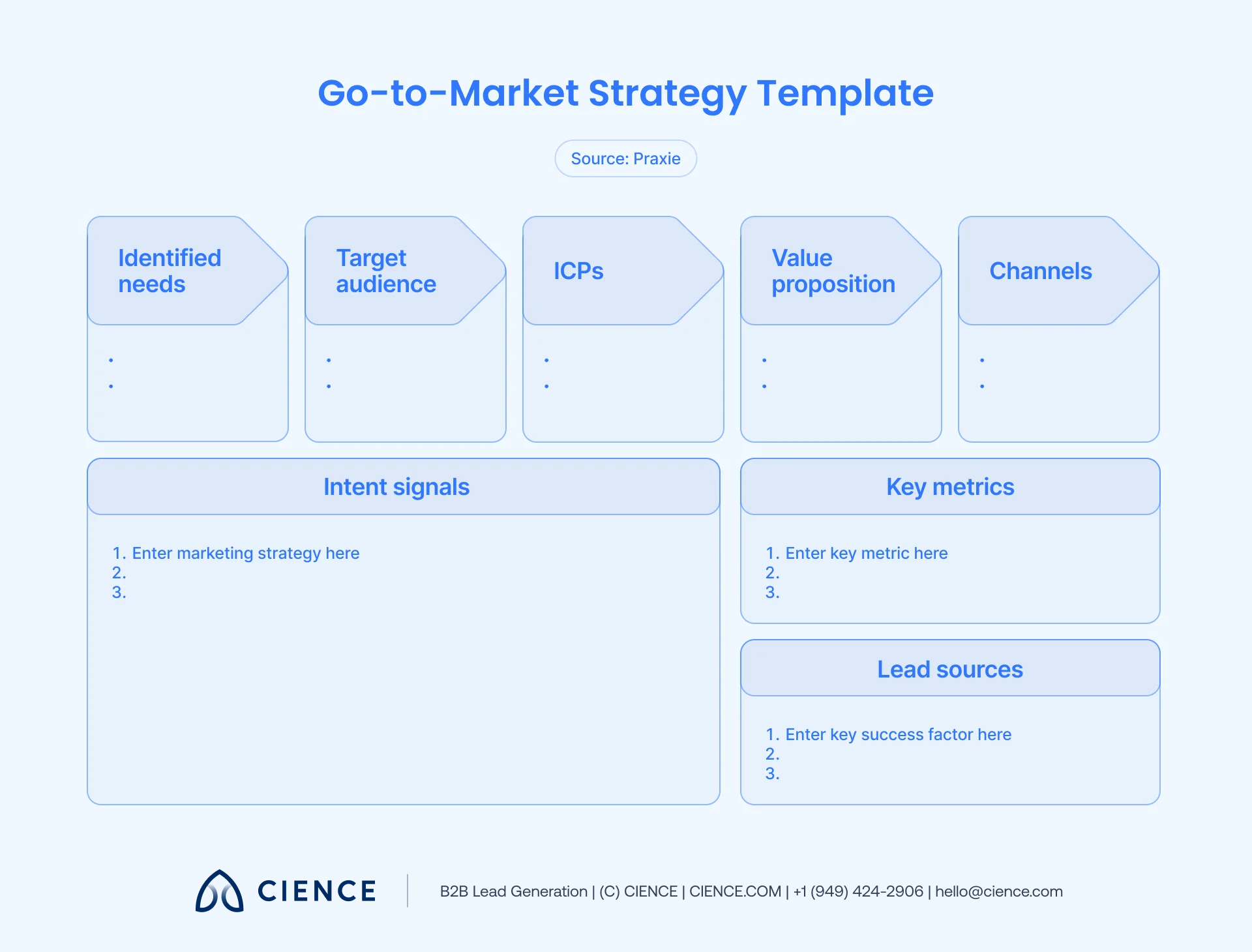
While the same go-to-market strategy template might not fit every B2B company out there, working with one certainly helps to increase the possibilities of connecting with prospects that are actively searching for your solution.
Here are some practical actions that should be considered in the design of every go-to-market strategy template:
1. Identify the need.
Most B2B products are created to solve one or more pain points derived from a specific niche, industry, or context. Nevertheless, marketing and sales teams still need to dissect every layer of the problem: how it originated, what are its more troublesome effects on the company, and how desperate future clients will be to solve it.
2. Outline your target audience.
Building accurate ICPs and buyer personas is crucial for any go-to-market strategy. While the ideal customer profile explains what companies and titles to target, the buyer persona describes how. Even when the product has not been released yet, it is possible to predict how the target audience will react thanks to previous research.
3. Understand the competency.
By analyzing the competitor’s proposal, you can define their strengths and weaknesses against your product. This data is highly valuable for sales development representatives (SDRs), who can use it to win leads that are already evaluating the competition.
4. Set your goals.
Key performance indicators (KPIs), objectives and key results (OKRs), and success factors need to be established from the very beginning of the GTM strategy. Measurable objectives will be key for understanding what actions need to be taken after the launching campaign is over.
5. Map the buyer’s journey.
By understanding the B2B buyer’s journey, marketers and sales professionals can craft a route of touchpoints and content pieces that will provide prospects with the information they need. While the sales cycle is not linear and involves multiple decision-influencers, a solid GTM strategy should cover as many scenarios as possible.
6. Tailor your messaging.
By learning how the ICP communicates, it is possible to personalize the messages that will be applied in live sales conversations, automated chats, email campaigns, ads, and more. Messages should focus on exalting the value proposition of your company and must be coherent with your brand’s tone.
7. Select your marketing channels.
Social media, programmatic advertising, blogs, newsletters, and other outbound channels can all be part of your go-to-market strategy. By aligning your marketing channels to your ICP criteria, you trigger positive responses at every step of the buyer’s journey, nurturing prospects until they are ready to make a purchase.
8. Choose intent signals.
Intent-based marketing is a hyper-focused approach that leverages customers’ intent data signals to create customized experiences. By mapping the topics, keywords, and content types your ICP searches for online, you’ll know which articles, videos, and content will perform best.
9. Prioritize lead sources.
Once the GTM strategy is on the run, handpicking the prospects with a higher probability of conversion is vital for the success of the lead generation campaign:
- Inbound-led outbound leads. These are the first to engage with the brand’s website.
- Intent-led outbound leads. These leads are interested in the topics surrounding your product.
- List-led outbound leads. These are contacted with cold, multichannel interactions.
10. Generate data-based insights.
One of the most important elements of go-to-market strategies is the customer data that can be obtained from it. The results of a launching campaign can become the fuel that ignites the engines of new lead generation processes. Deploying the right tools to manage, process, and leverage all the collected data is an essential part of the process.
If your cost-per-meeting keeps climbing despite adding tools and reps, the problem isn’t execution — it’s the model.
Go-to-Market Digital Tools
graph8 has built a suite of purpose-trained GTM tools — used by 2,500+ clients across 250+ industries — that map to each step of the go-to-market process. Here’s how they fit:
CIENCE GO Data
CIENCE GO Data is a sales intelligence platform that organizes, filters, and grants access to over 300 million records of real-life validated leads from all industries that match preconfigured ICP criteria and sources dynamic audience lists for use in the following lead gen efforts.
By deploying GO Data, B2B marketing teams can craft the target account lists they need to group top-tier ICPs that share a common problem, mapping the buyer’s journey on the way.
CIENCE GO Intent
CIENCE GO Intent analyzes billions of intent data signals from verified users, matches companies’ IP addresses, and tracks underlying buyer intent topics across the web. By matching users against your ICP, it’s possible to prioritize in-market buyers for outbound outreach.
This tool helps identify what keywords, topics, and content pieces are most requested by your B2B target audience, which are working best for your direct competitors, and which marketing channels are most likely to convert.
CIENCE GO Digital
CIENCE GO Digital is a demand-side platform (DSP) that is able to launch display, video, or audio ads to generate sales-driven interactions from ICPs. That means that you can personalize your ad campaigns depending on the segmented audiences that match your ICPs, improving the performance of your ads.
GO Digital is perfect for tailoring outbound messaging to talk about the value proposition of your brand and how it solves the needs of your target audience. It also provides clear KPIs of how many leads are entering pipelines and how this information can become insights to boost the outcome for the next stage of your marketing mix.
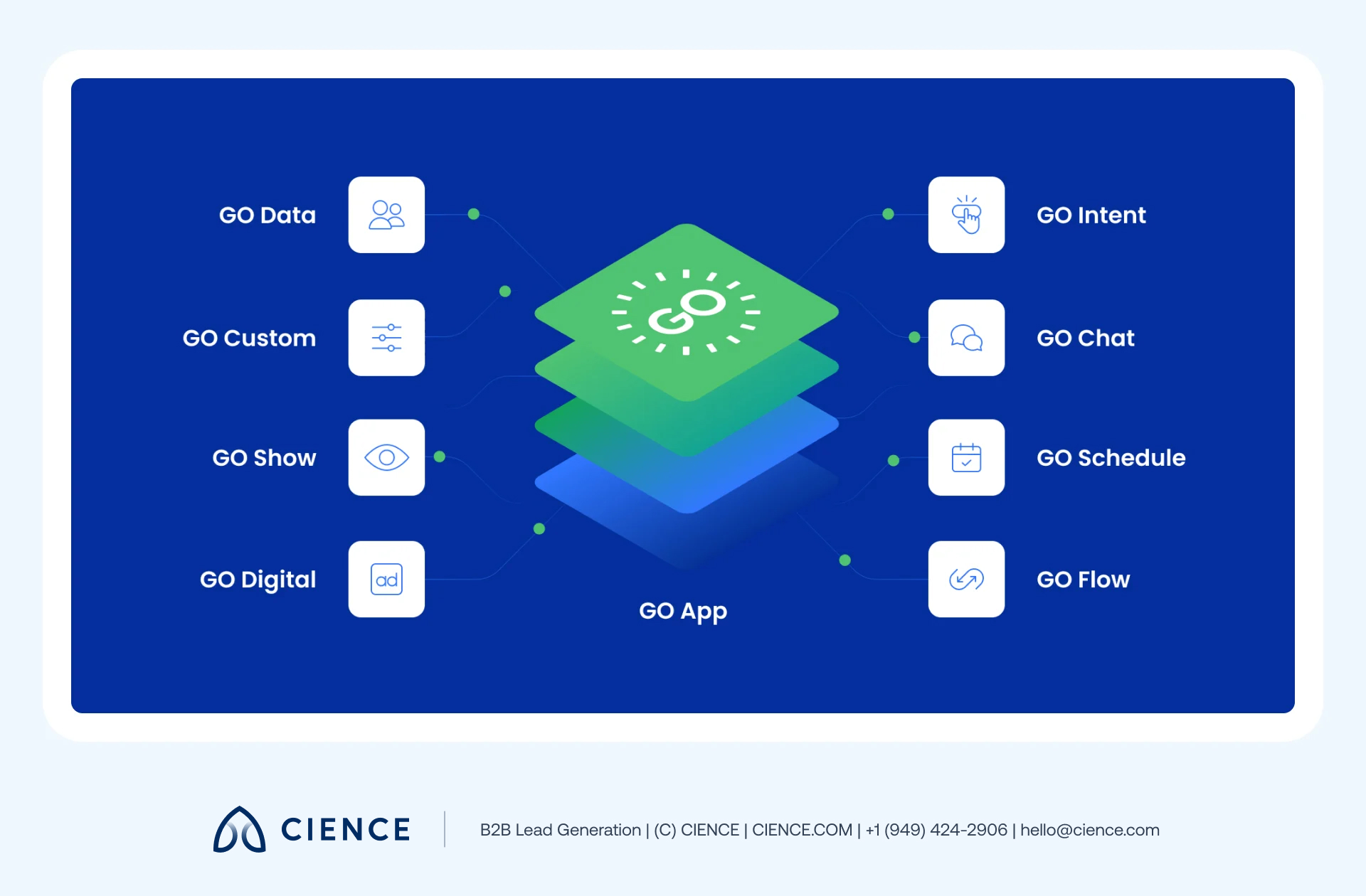
CIENCE GO Chat
CIENCE GO Chat is an always-on, agent-enabled AI chatbot that promotes sales-focused conversations with users and allows prospects to book meetings with sales representatives.
CIENCE GO Show
CIENCE GO Show is a visual ID system that helps identify anonymous website traffic. The GO Show software recognizes companies, departments, seniority levels, and even individual contact details of web visitors — making lead source prioritization far easier.
CIENCE GO Flow
CIENCE GO Flow is a data ingestion engine for sophisticated, data-powered sales and marketing teams. The GO Flow streamer delivers data batches to multiple destinations by applying pre-established routing rules in the platform.
CIENCE GO Schedule
CIENCE GO Schedule is a smart booking software that coordinates the team’s and prospect’s existing calendars to schedule meetings — ensuring every lead generated by your GTM strategy can be reached by your sales force.
Discover All CIENCE GO Data Products
Go-to-Market Strategy Examples
Most well-positioned B2B companies that exist today began with a powerful GTM campaign.
The following go-to-market strategy examples help to illustrate the effects of implementing a GTM structure and its transition into a solid everyday B2B marketing strategy:
Deel
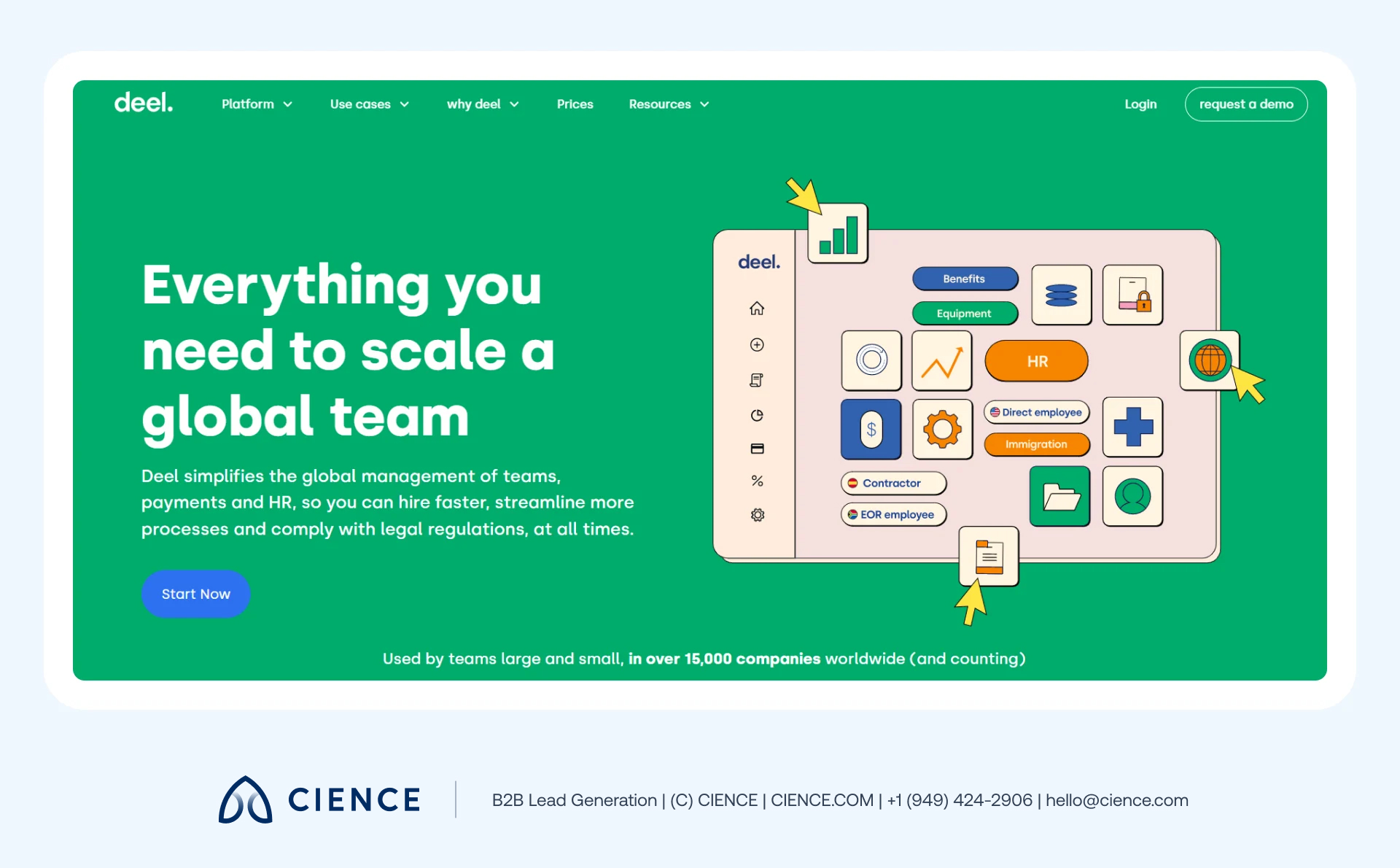
Deel is a SaaS platform that provides hiring and payments services for companies hiring international employees and contractors. It simplifies compliance, payroll, and HR (human resource) matters for globally distributed teams.
When Deel was founded back in 2018, it understood that global B2B companies had a major pain point while managing their workers: They were forced to use different platforms to manage international HR assets.
What makes Deel such an outstanding go-to-market strategy example is the way the company deployed a massive outbound campaign during the COVID-19 pandemic, resulting in an explosive amount of new closed deals. This allowed them to raise new venture capital funding at a $12 billion valuation.
Notion
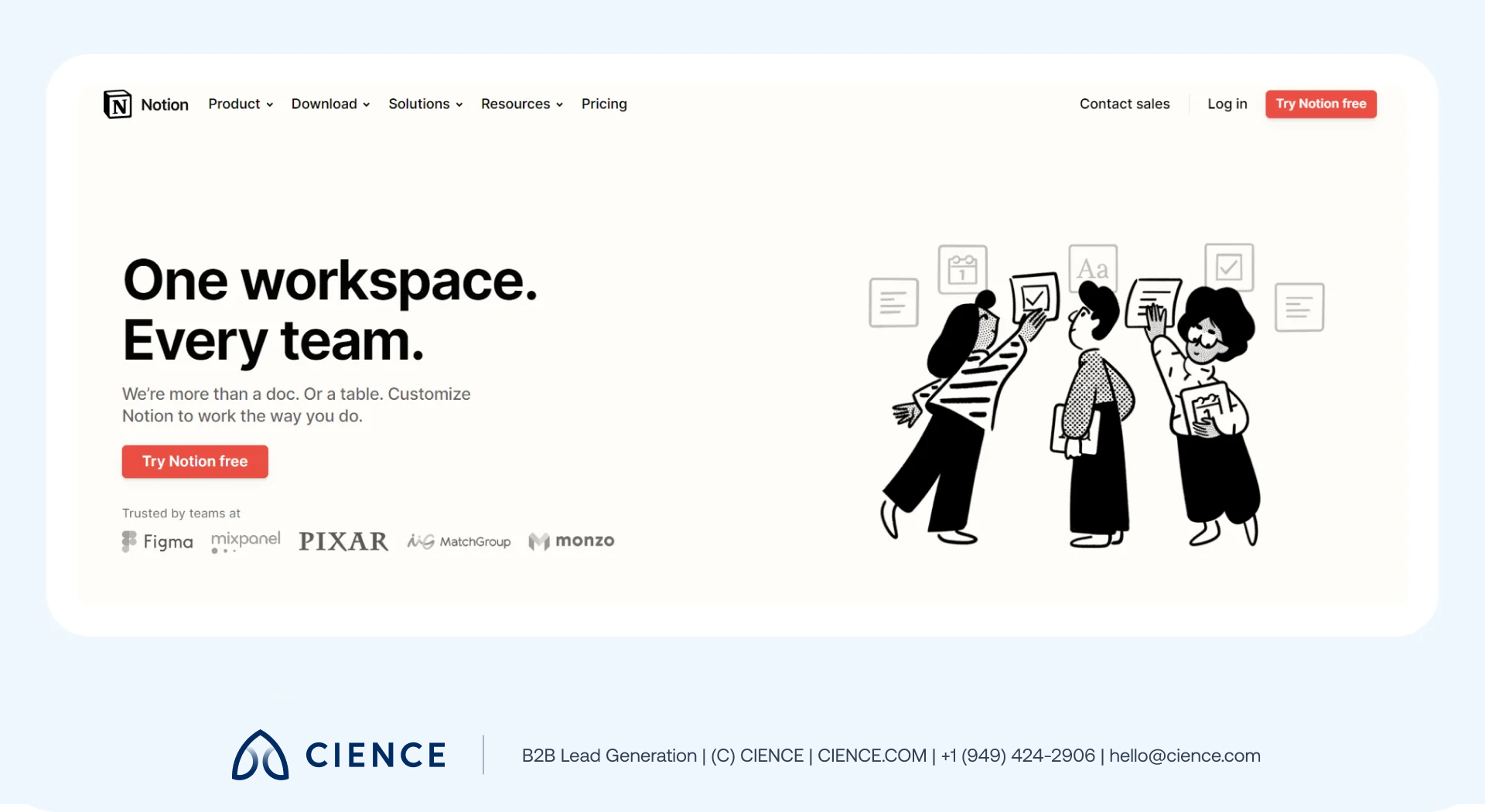
The next go-to-market strategy example is Notion, a project management software that is able to easily organize and manage meeting notes, HR documents, workflows, design templates, and much more.
Notion discovered that many project management tools were complex to leverage by some coworkers, so they decided to push a unique value proposition: They made it look fun. Notion’s interface is quite fluent, allowing users to create to-do lists, take notes about their tasks, rearrange blocks, and combine small jobs into a big one.
By combining functions of many other tools (like Evernote, Google Docs, and Google Sheets) and providing over 250 helpful integrations, Notion is quickly becoming a top choice platform for B2B companies all over the world, raising over $343.2 million in capital.
Typeform
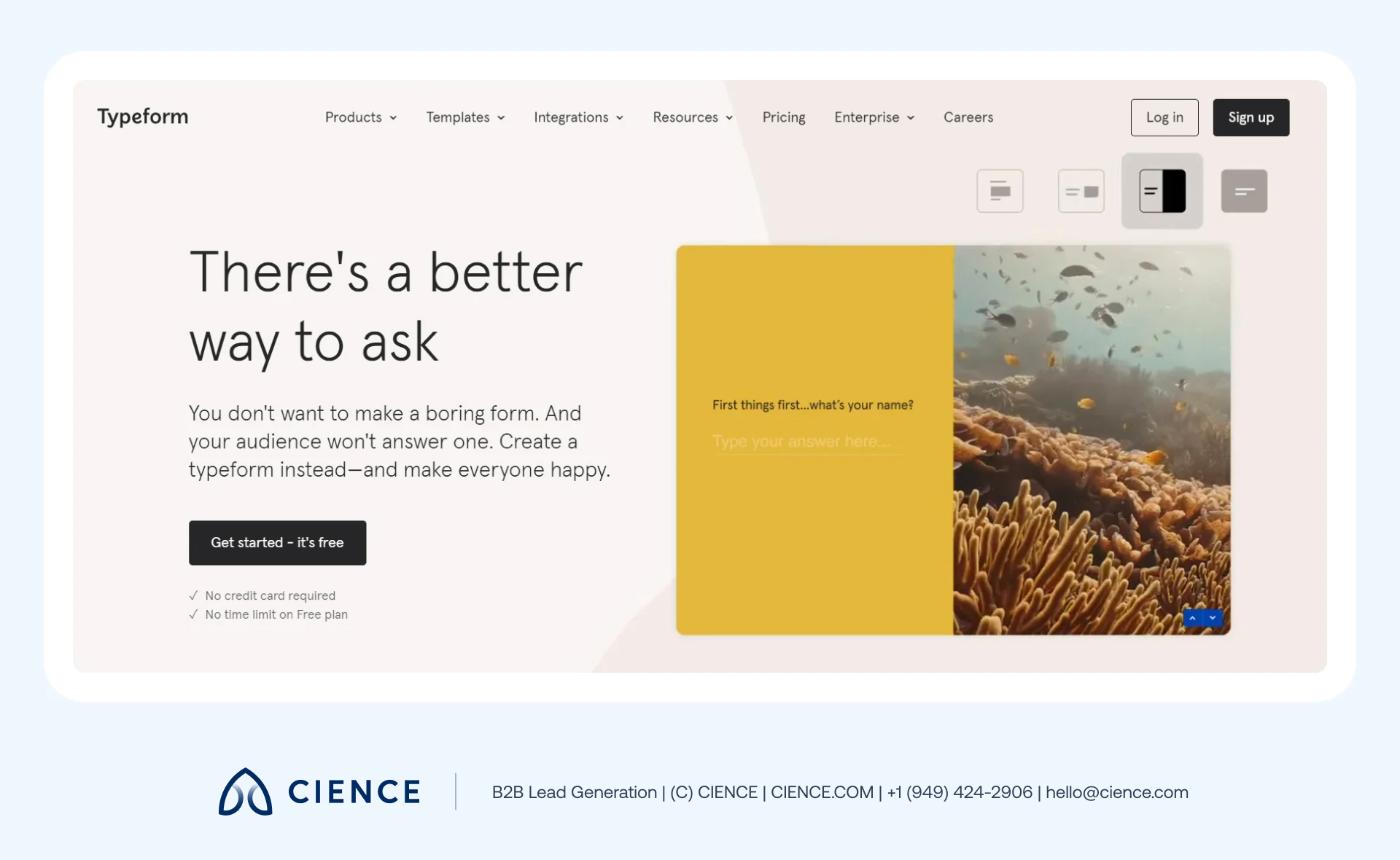
Another great go-to-market strategy example is Typeform, a SaaS platform that lets marketing teams create dynamic forms, surveys, and quizzes. The company relied on a robust outbound marketing campaign to connect with marketing research companies, aiming to connect with their direct ICPs.
The pain point that Typeform aims to solve is the dullness involved in requesting first-hand information from users. By integrating photo and video libraries, custom layouts, and several themes, this tool separates from the most traditional competitors.
A major differentiator from Typeform is that it shows one question at a time, driving a more holistic approach into the conversation. This engages users from the start, which makes them provide insightful responses and generate higher completion rates. The company has raised over $187.3 million.
Slack
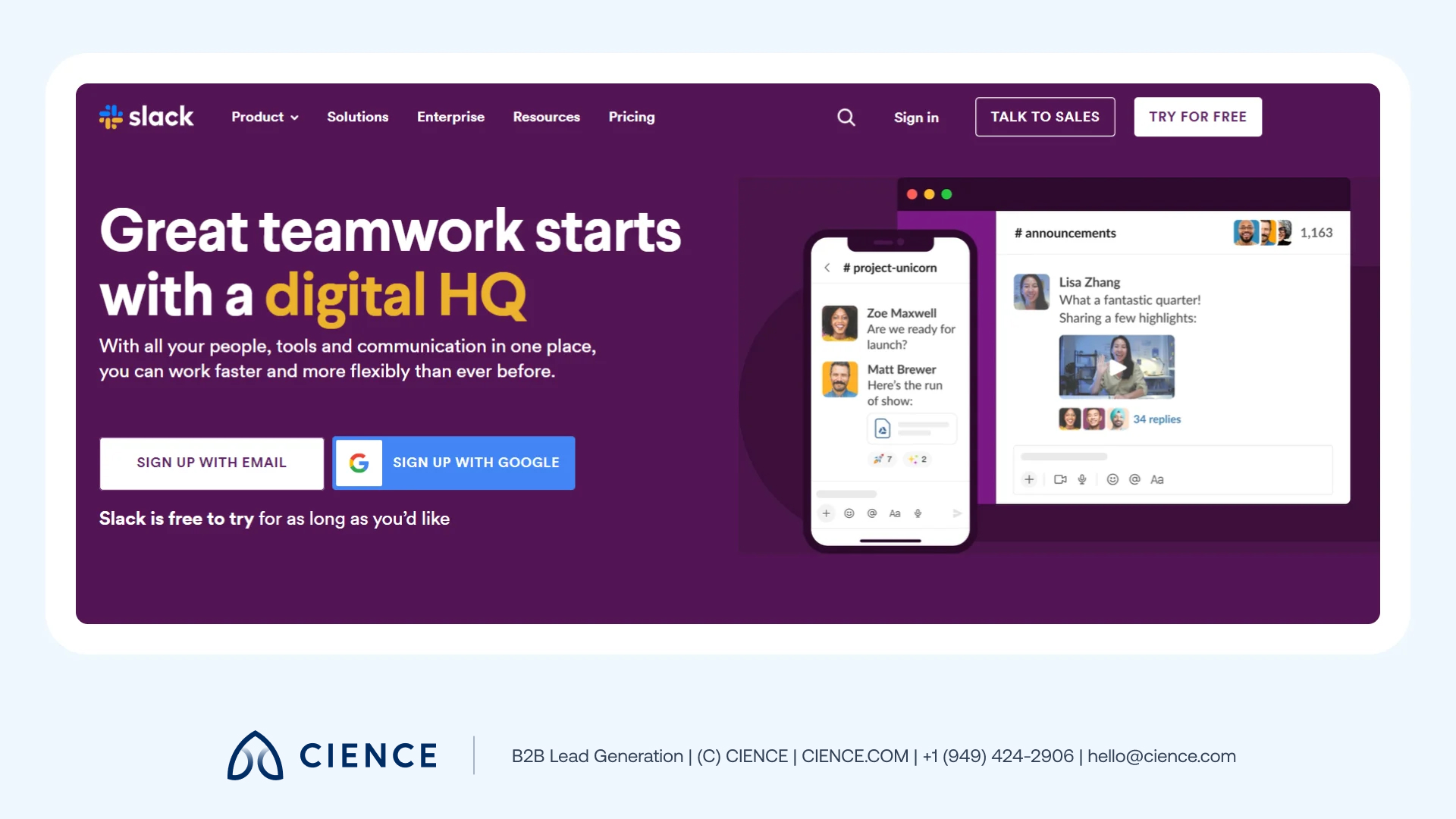
Many B2B marketing reps will be familiar with Slack. This instant messaging program has been able to integrate all work communications in one single place. By providing numerous integrations and a mobile app format, Slack has allowed teams to stay in touch in a simple and straightforward manner.
Slack was launched to the public in August 2013. By launching a free beta version of the platform, it became one of the fastest-growing business apps by relying on the power of word-of-mouth. Nowadays, it deploys heavy inbound and outbound campaigns to maintain its relevance, and access new customers.
The value proposition behind Slack is its friendly, fully customizable and intuitive UX/UI design, which users found refreshing and helpful in their daily conversations. It has raised over $1.4 billion to date.
Launch Your Product With CIENCE
“60% of our early sales revenue was directly attributed to CIENCE’s outreach. They became an essential part of our go-to-market execution from day one.” — Armatic
CIENCE + graph8 pricing: $5,000 one-time GTM system setup, $2,499/mo strategic execution, and the graph8 platform at $499/mo. No long-term contracts. See full pricing →
Whether or not you decide to work with us, you’ll walk away with a clear picture of where your pipeline is leaking and what it would take to fix it.
“CIENCE tripled our weekly meetings booked within the first few months. That velocity gave us the data we needed to refine our GTM model fast.” — Mandolin
Frequently Asked Questions
What is a go-to-market strategy?
A go-to-market (GTM) strategy is a tactical plan that outlines how a company will launch a product or enter a new market. It covers target audience identification, competitive positioning, pricing, marketing channels, and sales processes to maximize the chances of a successful launch.
How long does it take to build a go-to-market strategy?
Most B2B go-to-market strategies take 4 to 12 weeks to develop, depending on the complexity of the product and market. The process includes ICP research, competitive analysis, messaging development, and channel planning before the actual launch campaign begins.
What is the difference between a GTM strategy and a marketing strategy?
A GTM strategy focuses specifically on launching a new product or entering a new market, while a marketing strategy is an ongoing plan for promoting an existing business. GTM strategies are time-bound and launch-focused; marketing strategies are continuous and cover the full customer lifecycle.
Leverage GTM Strategies to Close More Deals
Go-to-market strategies are the foundation of efficient marketing campaigns. The data resulting from the earliest efforts to establish a brand, generate leads, and close deals will be vital for the development of lead generation processes, so each step should be followed with as much consciousness as possible.
While GTM strategies anchor a product’s launch, the intelligence gained carries forward — applied to every new product, rebranding campaign, or market expansion. Companies that treat GTM as a learning engine, not a one-time checklist, consistently make sharper decisions at every stage of growth.

A graph8 company — AI-powered GTM execution across 250+ B2B industries.
graph8 Platform
From $499/mo
Run your own GTM campaigns with AI-powered data, sequences, and analytics.
Start Free — 2,500 Credits No credit card requiredCIENCE Managed
From $2,499/mo
Our GTM teams build and run your outbound campaigns end-to-end.
15-min call · No commitment2,500+ B2B companies served · Month-to-month contracts · See full pricing →